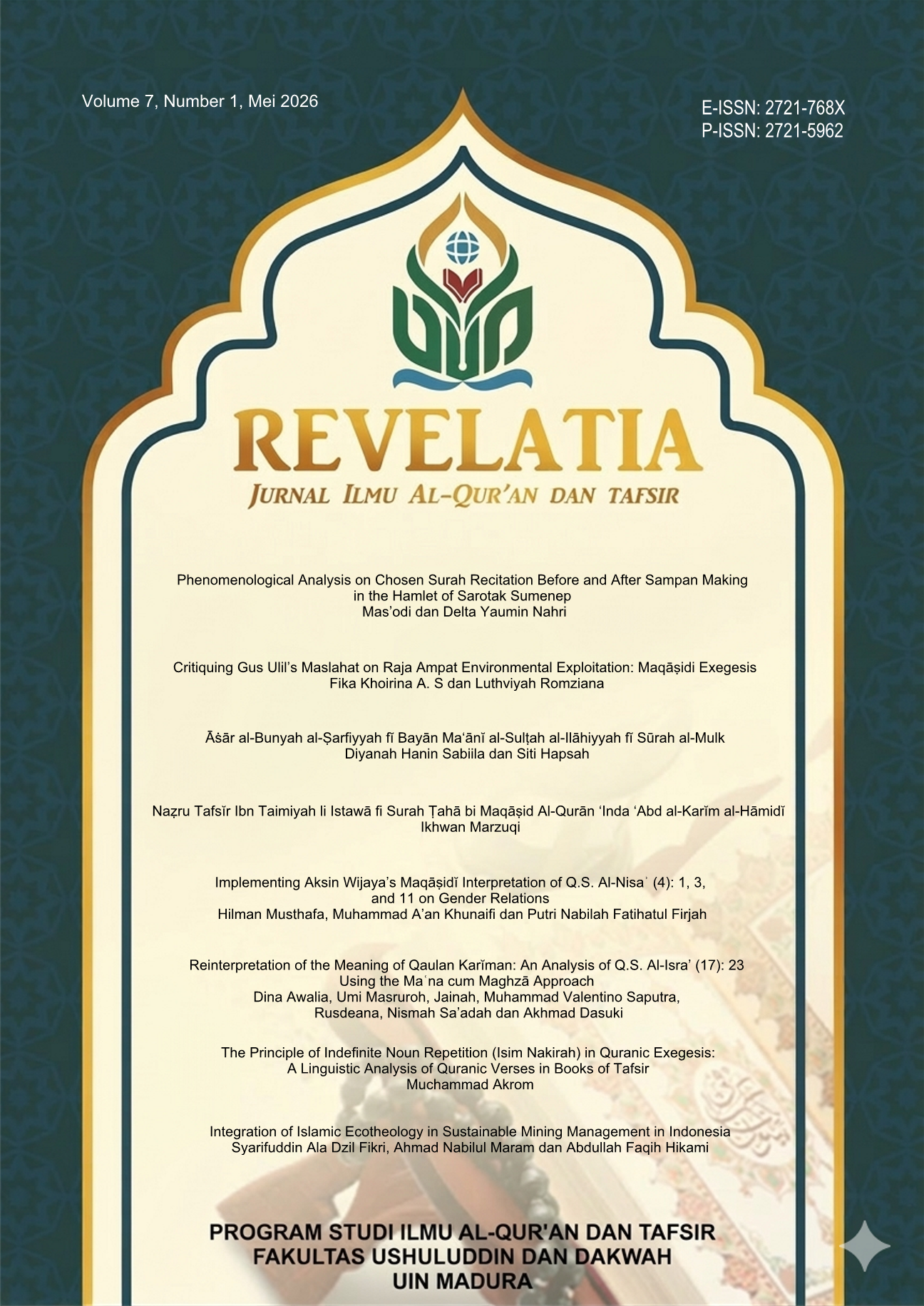
The Principle of Indefinite Noun Repetition (Isim Nakirah) in Quranic Exegesis:
A Linguistic Analysis of Quranic Verses in Books of Tafsir
DOI:
https://doi.org/10.19105/revelatia.v7i1.21788Keywords:
Noun Repetition, Nakirah, Linguistic Study, Tafsir Literature, Qur’anic ExegesisAbstract
This study is driven by the question of how the rule of repetition of indefinite nouns (isim nakirah) is applied in the interpretation of several Qur’anic verses. It is grounded in the diversity of interpretations found in tafsir literature regarding the use of this rule, as well as the varied understandings of the function of such repetitions. Theoretically, this research positions itself as an evaluation of the applicability and relevance of linguistic principles in interpreting Qur’anic verses. This study employs a qualitative method through library research, examining various primary tafsir sources to identify patterns of acceptance or rejection of this rule. The findings reveal that the application of the repetition of indefinite nouns is interpreted in diverse ways in Qur’anic exegesis. Some exegetes interpret it as emphasis and reinforcement (takrÄr wa ta’kÄd), such as al-ZamakhsharÄ, Quraish Shihab, and the Indonesian Ministry of Religious Affairs’ Tafsir, while others, such as Ibn KathÄr and al-SuyÅ«á¹Ä, apply a differentiation of meaning based on the aghlabiyyah principle, although certain scholars like al-ZamakhsharÄ and Quraish Shihab also employ this principle in other Qur’anic contexts. This diversity of interpretation is evident in the varying meanings attributed to terms such as yusrÄ, á¸a‘f, quwwah, and a‘mÄ. This study highlights the importance of a focused examination of the repetition of indefinite nouns by demonstrating the unique variations in the application of linguistic rules among exegetes, thereby raising significant issues regarding the flexibility and dynamic nature of linguistic methodologies in Qur’anic interpretation, a topic that has often been treated only in general terms.
Downloads
References
‘AqÄl, ’Ibn. Syarḥ ’Ibn ‘AqÄl ‘AlÄ â€™AlfiyÄh ’Ibn MÄlik. Beirut: DÄr al-Fikr, 2003.
‘Aá¹Ä, ’UsÄmah Aḥmad. QÄidah TakrÄr al-Nakirah Nakirah fi Ayy al-Å»ikr al-ḤakÄm. 2023, 463–538.
’Aqá¹£Ä, Muḥammad. “Kaidah-Kaidah Tentang Penafsiran Al-Qur’anâ€. Jurnal Warta 49, (Juli 2016). https://dx.doi.org/10.46576/wdw.v0i49.160.
Al-‘AsymÅ«nÄ, Muḥammad MuḥyÄ al-DÄn ‘Abd al-ḤamÄd. Syarḥ al-‘AsymÅ«nÄ â€˜alÄ â€™AlfiyÄh ’Ibn MÄlik. Beirut: DÄr al-KitÄb al-‘ArabÄ, 1955.
Al-Aá¹£fihÄnÄ, Al-RÄghib. Al-MufradÄt fÄ GarÄb al-Qur’Än. Mekkah: Maktabah NizÄr al-Muá¹£á¹afÄ al-BÄz, 2009.
Al-BukhÄrÄ, Muḥammad ’Ibn ’IsmÄ‘Äl. á¹¢aḥÄḥ BukhÄrÄ. Karachi: al-BusyrÄ, 2016.
Al-DamanhurÄ, Aḥmad ‘Ibn ‘Abd al-MunÄm. Ḥilyah al-Lubb al-Maṣūn. Beirut: Maktabah Al-’Ashriyyah, 2019.
Al-DimasyqÄ, AbÅ« al-FidÄ’ ‘IsmÄ‘Äl ’Ibn KaṡÄr. TafsÄr al-Qur’Än al-‘AẓÄm. Beirut: DÄr ’Ibn Hazm, 2000.
Al-ḤalabÄ, al-SamÄn. Al-Durr al-Maṣūn fi ‘UlÄm al-KitÄb al-MaknÅ«n. Damaskus: DÄr al-Qalam, 2013.
Al-Khuá¸ÄrÄ, Muḥammad. Hasyiyah Khuá¸arÄ â€˜AlÄ Syarḥ ’Ibn ‘AqÄl ‘AlÄ â€™Alfiyah ’Ibn MÄlik. Beirut: DÄr al-Fikr, 2003.
Al-NadirÄ, Muḥammad As‘ad. Naḥw al-Lughah al-‘Arabiyyah. Beirut: al-Maktabah al-‘Ashriyyah, 1994.
Al-Sabt, KhÄlid ’Ibn ‘UṡmÄn. QawÄ’id al-TafsÄr Jam’an wa DirasÄh. DÄr ’Ibn ‘AffÄn, 1421.
Al-SubkÄ, BahÄ’ al-DÄn. ‘ArÅ«s al-AfrÄḥ fÄ Syarḥ TalkhÄá¹£ al-MiftÄḥ. Beirut: Maktabah al-‘Aá¹£riyyah, 2003.
Al-SuyÅ«á¹Ä, JalÄl al-DÄn, dan JalÄl al-DÄn al-MaḥallÄ. TafsÄr al-JalÄlain. Kairo: Maktabah Al-Iman, 2016.
Al-SuyÅ«á¹Ä, JalÄl al-DÄn. Al-ItqÄn fi ’UlÅ«m al-Qur’Än. Beirut: Resalah Publishers, 2008.
------.Syarḥ ‘UqÅ«d al-JumÄn fi Ma‘ÄnÄ wa al-BayÄn. Beirut: DÄr al-Kutub al-‘ilmiyyah, 2011.
------. Tafsir Ad-Durr Al-Mantsur fi Al-Tafsir Al-Ma’tsur. Beirut: Dar Al-Fikr, 2011.
Al-ZamakhsyarÄ, MaḥmÅ«d ’Ibn ‘Umar. TafsÄr al-KasysyÄf. Beirut: DÄr al-Ma‘rifah, 2009.
Al-ZarkasyÄ, Badru al-DÄn Muḥammad. Al-BurhÄn fÄ â€˜UlÅ«m al-Qur’Än. Kairo: DÄr al-ḤadÄṡ, 2006.
Al Qifari, Abudzar. “Nakirah dan Ma’rifah Fii Al-Qur’an.†Shaut Al-’Arabiyah, 1, vol. 10, no. 1 (2022): 107–14. https://doi.org/10.24252/saa.v10il.29432.
Jamil, Sukron, dan Alwizar. “Kaidah Bahasa Dalam Menafsirkan Al-Qur’anâ€. Jurnal Pendidikan dan Pemikiran 20, no.1 (Mei 2025): 1895–1904. https://doi.org/10.55558/alihda.v20i1.265
Mazuki, M. Tahrum, dan Alwizar. “Kaidah Bahasa Dalam Menafsirkan Al-Qur’anâ€. Hamalatul Qur’an: Jurnal Ilmu-Ilmu Al Qur’an 5, no. 2 (2024): 98–113. https://doi.org/10.37985/hq.v5i2.163.
Mutakin, Ali. “Kedudukan Kaidah Kebahasaan dalam Kajian Tafsirâ€. Al-Bayan: Jurnal Studi Al-Qur’an dan Tafsir 1, no.2 (Desember 2016): 79–90.
Nasution, Husaini, dan Al-Wizar. “Kaidah Bahasa Arab Dalam Menafsirkan Al-Qur’anâ€. Hamalatul Qur’an: Jurnal Ilmu-Ilmu Al Qur’an 5, no. 2 (2024): 593–605. https://doi.org/10.37985/hq.v5i2.335
RI, Kementerian Agama. Al-Qur’an Dan Tafsirnya (Edisi yang Disempurnakan). Ikrar Mandiri Abadi, 2011.
Shihab, M. Quraish. Kaidah Tafsir. Lentera Hati, 2019.
Shihab, M. Quraish. Tafsir Al-Mishbah. Lentera Hati, 2002.
Yusron, M. Agus. “Kaidah Yang Diperlukan Mufassirâ€. Tafakkur: Jurnal Ilmu Al-Qur’an dan Tafsir 2, no. 1 (2021): 63–86.
Downloads
Published
Issue
Section
License
The journal operates an Open Access policy under a Creative Commons Non-Commercial Share-Alike license. All articles published Open Access will be immediately and permanently free for everyone to read and download.
• Creative Commons Attribution-NonCommercial (CC-BY-NC)

Revelatia: Jurnal Ilmu al-Qur`an and Tafsir by http://ejournal.iainmadura.ac.id/index.php/revelatia is licensed under a Creative Commons Attribution-NonCommercial 4.0 International License.
Based on a work at http://ejournal.iainmadura.ac.id.