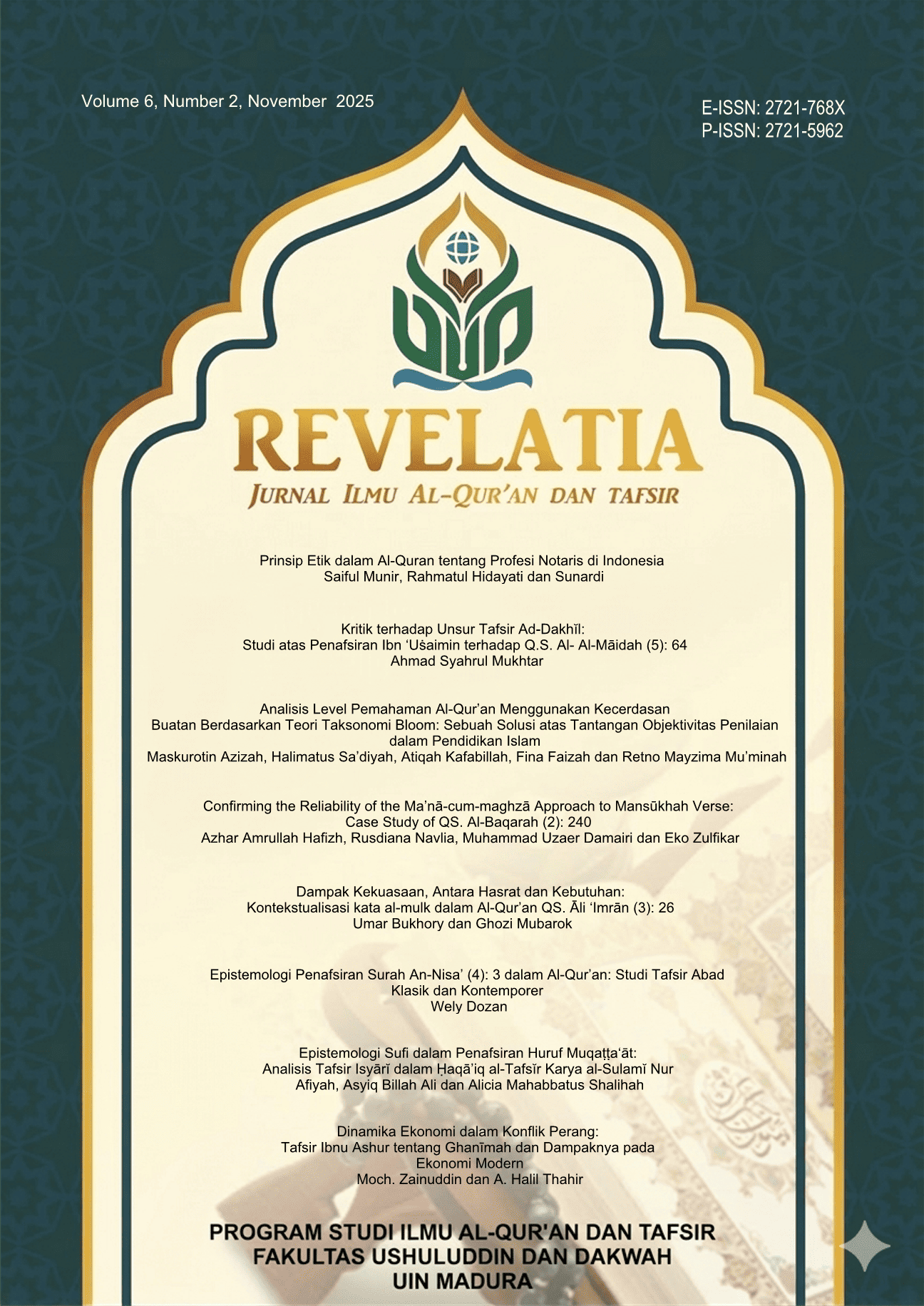
Confirming the Reliability of the Ma’nÄ-cum-maghzÄ Approach to MansÅ«khah Verse:
Case Study of QS. Al-Baqarah (2): 240
DOI:
https://doi.org/10.19105/revelatia.v6i2.21132Keywords:
Ma’nÄ-cum-maghzÄ, Sahiron, MansÅ«khah verses, ReliabilityAbstract
In the ma’nÄ-cum-maghzÄ approach to Qur'anic interpretation, Sahiron states that the paradigm that builds this approach is the absence of nasakh in the Qur'an. This raises questions about the existence of verses that are considered mansÅ«khah in the Qur'an, which for most tafsir scholars is positioned as a consensus. This article seeks to examine the reliability of the ma’nÄ-cum-maghzÄ approach, especially in the meaning and significance of verses that are considered mansÅ«khah by most scholars of interpretation and reveal the significance and meaning of QS. Al-Baqarah verse 240 regarding the length of the iddah period for women whose husbands die is one full year. This research is a type of library research with a ma’nÄ-cum-maghzÄ approach to the mansÅ«khah verse which is analyzed using content analysis. This study shows that, first, the ma'nÄ-cum-maghzÄ approach is quite reliable in interpreting QS. Al-Baqarah verse 240 because there are still scholars who interpret it based on negating nasakh, such as al-Tabari and al-Razi. In addition, the ma'nÄ-cum-maghzÄ approach reinforces the universal values contained in the Qur'an. Second, QS. Al-Baqarah verse 240 is a way for the Rasulullah Saw., gradually, to position women with dignity both economically and socially. This study contributes to strengthening the ma'nÄ-cum-maghzÄ approach, which can be a methodological alternative in reading verses that have been understood as mansÅ«khah, while also opening up space for a more contextual reading of the Qur'an that is gender-equitable and oriented towards universal ethical values.
Downloads
References
Adinugraha, Hendri Hermawan. “Kewenangan Dan Kedudukan Perempuan Dalam Perspektif Gender: Suatu Analisis Tinjauan Historis†17, no. 1 (2018): 42–62. https://doi.org/10.24014/marwah.v17i1.4515.
al-BukhÄrÄ, AbÅ« AbdullÄh Muḥammad bin IsmÄÄl bin IbrÄhÄm. á¹¢ahÄh Al-BukhÄrÄ. Dar Thauq al-NajÄḥ, 1422.
Al-Qur’an, Lajnah Pentashih Mushaf. Al-Qur’an Dan Terjemahannya: Edisi Penyempurnaan. Jakarta: Lajnah Pentashih Mushaf Al-Qur’an, 2019.
Al-Qurá¹ubÄ, AbÅ« AbdullÄh Muḥammad bin Aḥmad bin AbÅ« Bakar. Al-JÄmi’ Li AhkÄm Al-Qur’Än. Beirut: Muassasah al-RisÄlah, 2006.
Al-RÄzÄ, AbÅ« ‘Abdillah Muhammad bin Umar bin al-Hasan bin al-Husain al-TaymÄ. MafÄtÄh Al-Ghaib. Beirut: Dar IhyÄ’ al-TurÄth al-‘ArabÄ, n.d.
al-ṬabarÄ, AbÅ« Ja’far Muḥammad Ibnu JarÄr. JamÄ’ Al-BayÄn ‘an Ta’WÄl Ay Al-Qur’Än. Kairo: DÄr Hijr, 2001.
Al-ZarkasyÄ, AbÅ« Abdillah Badr al-DÄn Muhammad bin Abdillah bin BahÄdir. Al-BurhÄn FÄ â€˜UlÅ«m Al-Qur’An. Beirut: DÄr al-Ma‘rifah, 1957.
Al-ẒuḥailÄ, Wahbah. Al-TafsÄr Al-MunÄr FÄ Al-AqÄdah Wa Al-SharÄah Wa Al-Manhaj. Beirut: DÄr al-Fikr, 2009.
Damin, Marbad Saleh. “The Historical Role of Women in Early Islam.†Journal of Tikrit University for Humanities 29, no. 2 (2022): 399–413. https://doi.org/10.25130/jtuh.29.2.2022.17.
Ghozali, Mahbub. Lebih Dekat Dengan Ma’na Cum Maghza Sahiron Syamsuddin. Yogyakarta: Suka Press, 2022.
Insi, Sajidan, Fatimah, Ali Akbar, and Hidayatullah Ismail. “Pemanfaatan Kaidah Tafsir Dalam Menafsirkan Nasikh Dan Mansukh Pada Al-Quran.†Al-Muhith 4, no. 1 (2025): 162–74. https://doi.org/10.35931/am.v4i1.5167.
Jasser Auda. “Maqasid Al-Shariah as Philosophy of Islamic Law: A Systems Approach.†Washington: The International Institute of Islamic Thought London, 2007.
Muchlisin, Annas Rolli, and Hierarki Nilai. “Penafsiran Kontekstual: Studi Atas Konsep Hierarki Nilai Abdullah Saeed.†MAGHZA: Jurnal Ilmu Al-Qur’an Dan Tafsir 1, no. 1 (2016): 19–30. https://doi.org/10.24090/maghza.v1i1.693.
Muzakky, Althaf Husein. “Interpretasi Ma’nÄ Cum MaghzÄ Terhadap Relasi Suami-Istri Dalam QS Al-MujÄdalah [58]: 1-4.†Hermeunetik: Jurnal Ilmu Al-Qur’an Dan Tafsir 4, no. 1 (2020): 183. https://doi.org/10.1234/hermeneutik.v14i1.6.
Parker, Lyn, and Helen Creese. “The Stigmatisation of Widows and Divorcees ( Janda ) in Indonesian Society.†Indonesia and The Malay World 4, no. 128 (2016): 1–6. https://doi.org/10.1080/13639811.2015.1111647.
Perempuan), Komisi Nasional Anti Kekerasan terhadap Perempuan (Komnas. Catatan Tahunan Tentang Kekerasan Terhadap Perempuan. Jakarta: Komnas Perempuan, n.d. https://komnasperempuan.go.id/.
Prasetyo, Kukuh, and Idzharul Haq. “Apakah Ayat NÄsikh Lebih Memnjamin Keadilan Gender Ketimbang Ayat MansÅ«kh? Pendekatan Uṣūl Fiqh Dan MaqÄá¹£id Al-SharÄ‘ah Terhadap QS Al-Baqarah (2): 234 Dan 240.†IJougs : Indonesian Journal of Gender Studies 6, no. 1 (2025): 98–121. https://doi.org/10.21154/ijougs.v6i1.11628.
Ratoni. “Naskh Dan Mansukh Dalam Al- Qur’an: Tinjauan Kritis Atas Pro Dan Kontra.†At-Ta’wil: Jurnal Pengkajian Al-Qur’an Dan at-Turats 3, no. 1 (2025): 19–41. https://doi.org/10.62490/tawil.v3i01.1320.
Rofiq, Yusril Ainur. “Nasikh Mansukh Perspektif Ibnu Abi Hatim Dalam Tafsir Al- Qur ’ an Al-Adzim.†Jurnal Semiotika-Q: Kajian Ilmu Al-Quran Dan Tafsir 3, no. 2 (2023): 240–55. https://doi.org/10.19109/jsq.v3i2.21498.
Rohinah, and Nisfi Anisah. “Solidaritas Janda: Pemberdayaan Perempuan Di PJJI Armalah Yogyakarta.†Musawa: Journal for Gender Studies 19, no. 2 (2020): 162. https://doi.org/10.14421/musawa.2020.192.157-171.
Sabrifha, Eli, and Mochammad Novendri S. “Implikasi Konsep Naskh Dan Mansukh Terhadap Istimbat Hukum.†Al Qalam: Jurnal Ilmiah Keagamaan Dan Kemasyarakatan 16, no. 6 (1907): 2521–38. https://doi.org/10.35931/aq.v16i6.1840.
Shihab, M. Quraish. Tafsir Al-Mishbah: Pesan, Kesan Dan Keserasian Al-Qur’an. Jakarta: Lentera Hati, 2002.
Syamsuddin, Sahiron. Hermeneutika Dan Pengembangan Ulumul Qur’an (Edisi Revisi Dan Perluasan). Yogyakarta: Pesantren Nawesea Press, 2017.
Syamsuddin, Sahiron. “Ma‘NÄ-Cum-Maghza Approach to the Qur’an: Interpretation of Q. 5:51.†Proceedings of the International Conference on Qur’an and Hadith Studies, 2017, 131–36.
Syamsuddin, Sahiron. Pendekatan Ma‘NÄ-Cum-MaghzÄ Atas Al-Qur’an: Paradigma, Prinsip Dan Metode Penafsiran. Yogyakarta: Pidato Pengukuhan Guru Besar, 2022.
Syamsuddin, Sahiron. “Pendekatan Ma’na-Cum-Maghza: Paradigma, Prinsip, Dan Metode Penafsiran.†Nun: Jurnal Studi Alquran Dan Tafsir Di Nusantara 8, no. 2 (2022): 1–24. https://doi.org/10.32495/nun.v8i2.428.
Syukrinur, Syukrinur. “The Correlation of Muhkam Verses With Nasikh and Mansukh in Islamic Legal Determination.†SINTHOP: Media Kajian Pendidikan, Agama, Sosial Dan Budaya 3, no. 1 (2024): 30–41. https://doi.org/10.22373/sinthop.v3i1.5436.
Downloads
Published
Issue
Section
License
The journal operates an Open Access policy under a Creative Commons Non-Commercial Share-Alike license. All articles published Open Access will be immediately and permanently free for everyone to read and download.
• Creative Commons Attribution-NonCommercial (CC-BY-NC)

Revelatia: Jurnal Ilmu al-Qur`an and Tafsir by http://ejournal.iainmadura.ac.id/index.php/revelatia is licensed under a Creative Commons Attribution-NonCommercial 4.0 International License.
Based on a work at http://ejournal.iainmadura.ac.id.