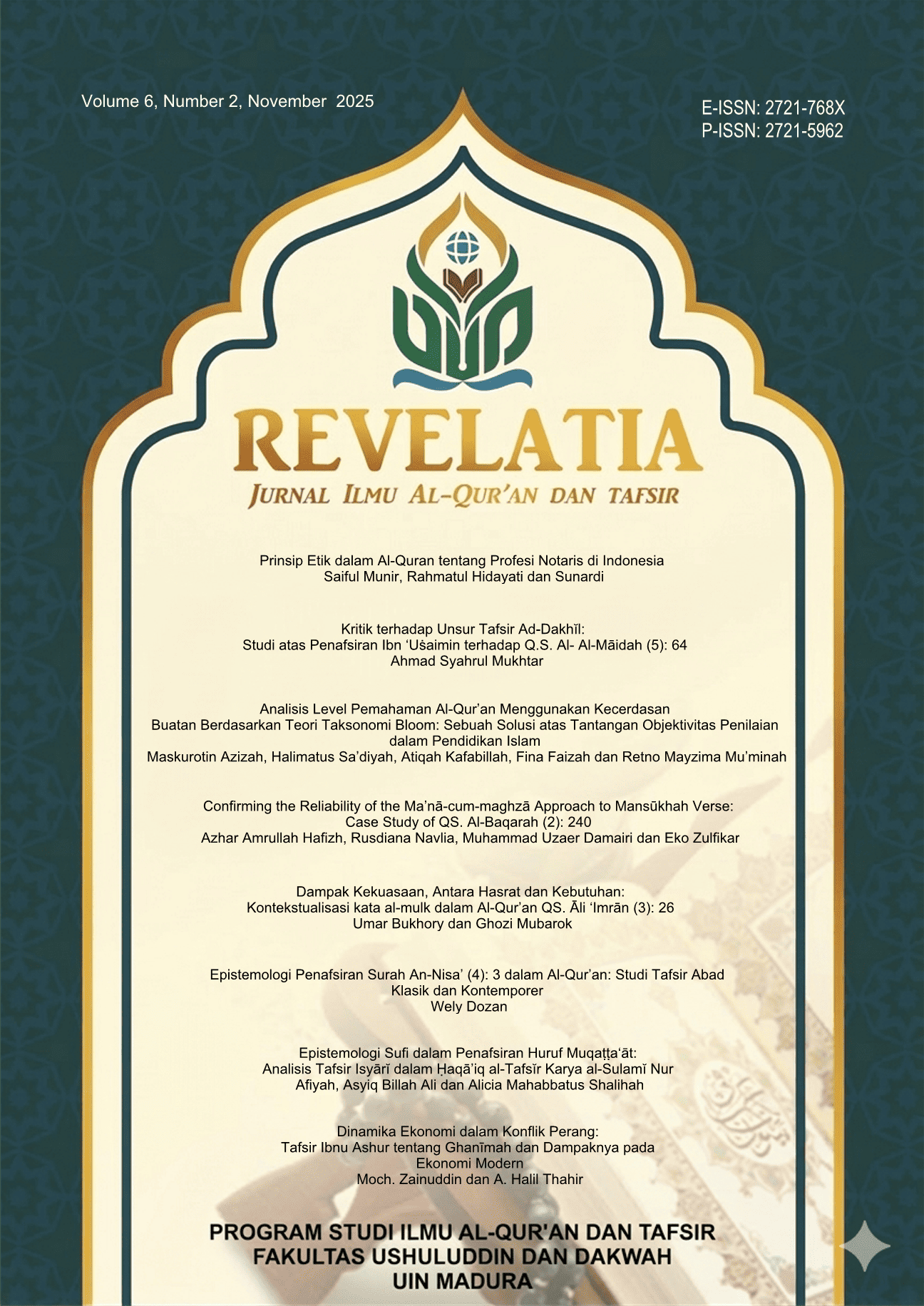
Epistemologi Sufi dalam Penafsiran Huruf Muqaá¹á¹a‘Ät:
Analisis Tafsir IsyÄrÄ dalam ḤaqÄ’iq al-TafsÄr Karya al-SulamÄ
DOI:
https://doi.org/10.19105/revelatia.v6i2.16434Keywords:
Sufi Tafsir, al-SulamÄ, ḤaqÄ’iq al-TafsÄr, Muqaá¹á¹a‘Ät Letters, IsyÄrÄ EpistemologyAbstract
Sufi exegesis of the isyÄrÄ type continues to be a subject of debate, as it is often regarded as subjective, weak in terms of verifiable transmission, and potentially prone to departing from the literal (ẓÄhir) meaning of the Qur’an. This article responds to these concerns by examining how AbÅ« ‘Abd al-RaḥmÄn al-SulamÄ (d. 412 H/1021 M) constructed an epistemic foundation for mystical interpretation in his work ḤaqÄ’iq al-TafsÄr, focusing specifically on the case of the muqaá¹á¹a’Ät (disjointed letters). This study employs a qualitative library-based approach, using ḤaqÄ’iq al-TafsÄr and al-SulamÄ’s works related to the malÄmatiyyah tradition as primary sources, supported by scholarship on the historical development of Sufism in KhurÄsÄn and the discourse on the science of letters. The analysis is conducted through qualitative content analysis and historical-contextual interpretation using an operational A-B-C coding scheme. The findings demonstrate that al-SulamÄ’s reading of the muqaá¹á¹a’Ät is not merely a form of individual symbolism, but rather a structured epistemic practice articulated through a stratification of meaning between ẓÄhir and isyÄrah, spiritual authorization mediated through networks of early Sufi authority, and an ethical-spiritual validation oriented toward transformative experience. This article highlights the contribution of this interpretive model while also acknowledging its limitations, particularly the requirement of coherence with the ẓÄhir meaning and adherence to the discipline of spiritual propriety (adab).
Downloads
References
Abbas, Agustiar, Hasan Basri, Sri Wulan Dari, Tama Erlanda Putri, Parisyi Algusyairi, dan Nurhayuni Nurhayuni. “Al-Qurán Dan Wahyu : Suatu Tinjauan Terminologis.†AL-MIKRAJ Jurnal Studi Islam dan Humaniora (E-ISSN 2745-4584) 4, no. 1 (2023): 67–81. https://doi.org/10.37680/almikraj.v4i1.3190.
Abdillah, Ihsan, dan Mochammad Rizky Baihaqi. “Ragam Corak Tafsir: Tafsir Sufi.†Mashadiruna Jurnal Ilmu Al-Qur’an dan Tafsir 3, no. 1 (2024): 23–30. https://doi.org/10.15575/mjiat.v3i1.33927.
Abdurrahman, U., Moh Najib, dan Ayi Sofyan. “Islamic Legal Paradigm and Methodology Philosophy and Sufi Interpretation.†West Science Social and Humanities Studies 1, no. 05 (2023): 282–94. https://doi.org/10.58812/wsshs.v1i05.412.
Abdurrahman, U., Moh Najib, dan Ayi Sofyan. “Islamic Legal Paradigm and Methodology Philosophy and Sufi Interpretation.†West Science Social and Humanities Studies 1, no. 05 (2023): 282–94. https://doi.org/10.58812/wsshs.v1i05.412.
Akbar, Ali. “Philosophical Hermeneutics and Contemporary Muslim Scholars’ Approaches to Interpreting Scripture.†Philosophy & Social Criticism 47, no. 5 (2021): 587–614. https://doi.org/10.1177/0191453720931912.
Akhyar, Muaddyl, Zulheldi, dan Duski Samad. “Studi Analisis Tafsir Al-Qur’an dan Relevansinya Dalam Pendidikan Islam.†INOVATIF: Jurnal Penelitian Pendidikan, Agama, dan Kebudayaan 10, no. 1 (2024): 38–57. https://doi.org/10.55148/inovatif.v10i1.780.
Anwar, Hamdani. “Isyarat dan Simbol dari Al-AḥrÅ«f Al-Muqaá¹á¹a’ah dalam Al-Qur’an.†Refleksi 19, no. 2 (2020): 183–200. https://doi.org/10.15408/ref.v19i2.16433.
Aulia Razmi, Arya. “Tafsir Sufistik dalam Sirah Nabawiyah: Analisis Teks al-SyifÄ’ karya al-QÄá¸Ä IyÄá¸.†Academic Journal of Islamic Principles and Philosophy 6, no. 1 (2025): 33–62. https://doi.org/10.22515/ajipp.v6i1.11167.
Chukhanov, Sansyzbay, dan Nurlan Kairbekov. “The Importance of a Semantic Approach in Understanding the Texts of the Holy Quran and Sunnah.†Pharos Journal of Theology, no. 105(3) (Juni 2024). https://doi.org/10.46222/pharosjot.105.36.
Coppens, Pieter. “Tafsir Studies and the Conundrum of Normativity.†Journal of Muslims in Europe 11, no. 1 (2022): 36–51. https://doi.org/10.1163/22117954-bja10041.
Dinata, Syaiful dan Jurnal Abdi Insani. “Upaya Guru Pendidikan Agama Islam (PAI) Dalam Menanamkan Nilai-Nilai Tazkiyatun Nafs Pada Siswa Smpn 1 Tempuling.†Jurnal Abdi Insani 9, no. 1 (2022): 58–66. https://doi.org/10.29303/abdiinsani.v9i1.467.
Fadli, Nazar. “Contribution of Acehnese Scholars to the Development of Quranic Exegesis in Indonesia: A Study of Tengku Muhammad Hasbi Ash-Shiddieqy and His Work ‘Tafsir An-Nuur.’†QiST: Journal of Quran and Tafseer Studies 3, no. 1 (2023): 1–22. https://doi.org/10.23917/qist.v3i1.3381.
Faisal Purnomosidi, Muhammad, Andri Nirwana An, dan Qoree Butlam. “The Application of the Principle of Coherence in Al-Hashr: Perspective of Qawaid Tafsir by Kholid bin Utsman Al-Sabt.†Profetika: Jurnal Studi Islam 25, no. 01 (2024): 15–32. https://doi.org/10.23917/profetika.v25i01.2500.
Hedlund, Åsa, Maria Eriksson Wester, Pia Edenvik, dkk. “A good autistic life: an autistic-led conceptualization of autistic flourishing through autistic women’s-lived experiences.†Frontiers in Sociology 10 (September 2025): 1611803. https://doi.org/10.3389/fsoc.2025.1611803.
Herlambang, Saifuddin, dan Syamsul Kurniawan. “Hegemony of Involvement of Tafsir in Political Identity.†ESENSIA: Jurnal Ilmu-Ilmu Ushuluddin 19, no. 1 (2018): 83–96. https://doi.org/10.14421/esensia.v19i1.1489.
Husna, Rifqatul. “Autentifikasi dan Infiltrasi dalam Tafsir IshÄrÄ.†MUṢḤAF Jurnal Tafsir Berwawasan Keindonesiaan 1, no. 2 (2021): 125–52. https://doi.org/10.33650/mushaf.v1i2.2089.
Irham, Irham. “Problem Pemaknaan Al-Quran Dalam Metode Tafsir Konvensional.†AL QUDS : Jurnal Studi Alquran dan Hadis 6, no. 1 (2022): 389. https://doi.org/10.29240/alquds.v6i1.3647.
Lutfhi, Muhammad, Kukuh Dwi Kurniawan, Yohana Puspitasari Wardoyo, dkk. “Tafsir Bi al-Ma’tsur: Concepts and Methodology.†KnE Social Sciences, advance online publication, 4 Oktober 2022. https://doi.org/10.18502/kss.v7i15.12140.
Maghribi, Hamdan, dan Alfina Hidayah. “Contesting the Exegetical Approaches of Muhammad Abduh and Fazlur Rahman to the Qur’Än.†Religia 26, no. 1 (2023): 40–57. https://doi.org/10.28918/religia.v26i1.865.
Mairizal, T. “Epistemologi Tafsir Ishari: Kajian terhadap Kitab Haqã’iq al-Tafsĩr karya Abu ‘Abd Al-Rahman Al-Sulamî.†Basha’ir: Jurnal Studi Al-Qur’an dan Tafsir 5, no. 1 (2025): 41–53. https://doi.org/10.47498/bashair.v5i1.4654.
Mushodiq, Muhamad Agus, dan Wahyudi Wahyudi. “Characteristics of Sufi Al-Sulamy’s Tafsir Method: A Case Study of the Prophet of Musa And khidir.†Jurnal At-Tibyan: Jurnal Ilmu Alqur’an dan Tafsir 5, no. 2 (2020): 213–39. https://doi.org/10.32505/at-tibyan.v5i2.1438.
Nguyen, Martin. “Exegesis of the ḤurÅ«f Al-Muqaá¹á¹a’a: Polyvalency in SunnÄ Traditions of Qur’anic Interpretation.†Journal of Qur’anic Studies 14, no. 2 (2012): 1–28. https://doi.org/10.3366/jqs.2012.0053.
Parwanto, Wendi, Taufik Akbar, dan AbdulGafar Olawale Fahm. “The Method of Interpretation on QS. Al-Fatihah in Tarjuman Al-Mustafid By Abdul Rauf As-Singkili.†QiST: Journal of Quran and Tafseer Studies 1, no. 3 (2022): 264–76. https://doi.org/10.23917/qist.v1i3.2388.
Reda, Nevin. “Holistic Approaches to the Qur’an: A Historical Background.†Religion Compass 4, no. 8 (2010): 495–506. https://doi.org/10.1111/j.1749-8171.2010.00233.x.
Rozy, Yahya Fathur. “The Development of Qur’an Commentators’ Requirements: From the Affirmative Era to the Reformative Era.†QiST: Journal of Quran and Tafseer Studies 3, no. 1 (2023): 75–90. https://doi.org/10.23917/qist.v3i1.2910.
Saeidi, Fateh. “The Early Sufi Tradition in HamadÄn, NahÄwand, and Abhar: Stories of Devotion, Mystical Experiences, and Sufi Texts.†American Journal of Islam and Society 40, no. 3–4 (2023): 104–35. https://doi.org/10.35632/ajis.v40i3-4.3210.
Salamah, Daris, Zaeni Anwar, Sekar Istiqomah, dan Teguh Arafah Julianto. “Kajian Tafsir Al-Qur’an dengan Pendekatan Sufistik: Analisis Karakteristik Penafsiran Haqa’iq al-Tafsir Karya al-Sulami.†AR ROSYAD: Jurnal Keislaman dan Sosial Humaniora 3, no. 2 (2025): 1–17. https://doi.org/10.55148/ar-rosyad.v3i2.1852.
Sartika, Ela, dan Amin Amin. “Examining Al-Khazin’s Influence on Tafsir Writing in Indonesia (A Study of 17th and 20th Century Tafsir).†Journal Analytica Islamica 12, no. 2 (2023): 319. https://doi.org/10.30829/jai.v12i2.18087.
Sofiudin, Muh. “Tasawuf Abd Al-Rahman Al-SulamÄ (Perspektif Historis).†Refleksi Jurnal Filsafat dan Pemikiran Islam 18, no. 2 (2018): 183–205. https://doi.org/10.14421/ref.v18i2.1865.
Sulami, Muhammad bin Husain bin Musa al-Azdi al-. HaqÄ’iq al-TafsÄr: TafsÄr al-Qur’Än al-’AzÄz. : : Dar al-Kutub al-Ilmiyyah, 2001.
Syarifuddin, Mohammad Anwar. “Measuring the Haqa’iq al-Tafsir: From its Contentious Nature to the Formation of Sunnite Sufism.†Journal of Qur’an and Hadith Studies 2, no. 2 (2013): 209–45. https://doi.org/10.15408/quhas.v2i2.1315.
Uthman, Ibrahim Olatunde. “The SharÄ’ah and the Muslim Feminists’ Public Display of the Female Body.†International Journal of Islamic Khazanah 12, no. 2 (2022): 114–24. https://doi.org/10.15575/ijik.v12i1.17510.
Welle, Jason. “WilÄya in Medieval KhurÄsÄnÄ Sufism, with Particular Reference to AbÅ« ‘Abd al-RaḥmÄn al-SulamÄ (d. 412/1021).†Journal of Islamic Ethics, 4 Juli 2025, 1–25. https://doi.org/10.1163/24685542-20250004.
Zulfa, Imarotuz. “Sahiron Syamsuddin’s Contributions to the Methodological Discourse of Al-Qur’an Interpretation in Indonesia.†TAFSE: Journal of Qur’anic Studies 8, no. 2 (2023): 141. https://doi.org/10.22373/tafse.v8i2.20133.
Zumrodi, Zumrodi. “Metode Tafsir IsyÄri dalam Kitab ‘HaqÄ’iq Al-TafsÄr’ Karya Abdul-Rahman Al-Sulami.†Esoterik 2 (Desember 2017): 370. https://doi.org/10.21043/esoterik.v2i2.1962.
Zumrodi, Zumrodi. “Metode Tafsir IsyÄri dalam Kitab ‘HaqÄ-Iq Al-TafsÄr’ Karya Abdul-Rahman Al-Sulami.†Esoterik 2, no. 2 (2017): 370. https://doi.org/10.21043/esoterik.v2i2.1962.
Downloads
Published
Issue
Section
License
The journal operates an Open Access policy under a Creative Commons Non-Commercial Share-Alike license. All articles published Open Access will be immediately and permanently free for everyone to read and download.
• Creative Commons Attribution-NonCommercial (CC-BY-NC)

Revelatia: Jurnal Ilmu al-Qur`an and Tafsir by http://ejournal.iainmadura.ac.id/index.php/revelatia is licensed under a Creative Commons Attribution-NonCommercial 4.0 International License.
Based on a work at http://ejournal.iainmadura.ac.id.