
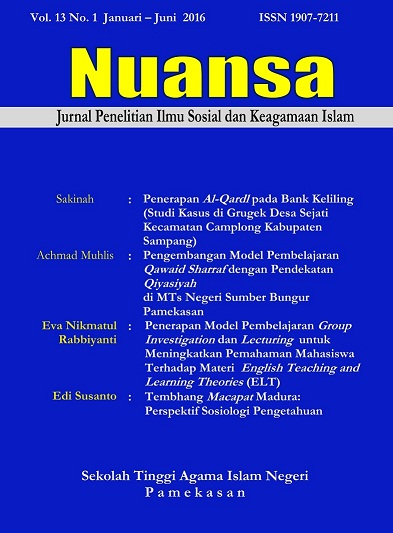
PENGEMBANGAN MODEL PEMBELAJARAN QAWAID SHARRAF DENGAN PENDEKATAN QIYASIYAH di MTs NEGERI SUMBER BUNGUR PAMEKASAN
DOI:
https://doi.org/10.19105/nuansa.v13i1.920Abstract
The research focuses that will be discussed are the description of learning model, students responses, and factors influencing the development of qawaid sharraf learning model by using  qiyasiyah approach. Based on the research result, it has been identified that there are four type of learning model that have been intensively and effectively applied to achieve better qualified learning. They are: firstly, basic competence and learning indicator based learning model; secondly, wazan memorizing by providing example of wazan fi’il madhi on the basis of thariqah tashrif bina’ shahih; thirdly, applying tashrif models on the al-Qur’an pronunciation. There are optimal and positive responses of students toward the development of qawaid sharraf learning model by using qiyasiyah approach, it is supported by the following indicators: (1) motivation emergence, (2) students learning interest increase, (3) students learning competence development, (4) the starting point of Arabic language improvement. In general, the main factor influencing the development of qawaid sharraf learning model by using qiyasiyah approach is the professional planning and process. However, there are several components that are able to endorse the efforts: (1) qualified schools management, (2) students recruitment, (3) teachers competence.Downloads
References
Arikunto, Suharsimi, Dasar-Dasar Evaluasi Pendidikan (Jakarta: Bumi Akasara, 2002)
Ahmad, Muhammad Abdul Qadir, Thuruqu Ta’lim al-Lughah al-‘Arabiyah (Beirut: Maktabah al-Nahdhah al-Mishriyah, 1989)
Arsyad, Azhar, Madkhal ila Thuruqi Ta’lim al Lughah al Ajnabiyah li Mudarris al Lughah al ‘Arabiyah (Ujung Pandang: al Ahkam, 1998)
Ali, Muhammad, Guru dalam Proses Belajar Mengajar (Bandung: Sinar Baru Algesindo)
Darsono, Belajar dan Pembelajaran. (Semarang: IKIP Semarang Press, 2000)
Djamarah, Saiful Bahri, Strategi Belajar Mengajar, (Jakarta: Rineka Cipta, 2002)
Departemen Pendidikan dan Kebudayaan, Kamus Besar Bahasa Indonesia (Jakarta: Balai Pustaka, 1990)
Fattah, Abdul, Musykilatul Lughah wa al-Takhatub fi Dhau’i al-“ilm al-Lughah al-Nafs (al-Qahirah: Dar al-Qubah, 2002)
Hamid, M. Abdul, Mengukur Kemampuan Bahasa Arab (Malang: UIN-Press, 2010)
Ibrahim, Abdul Halim, al-Muwajjah al-Fanni (Beirut: Dar al-Ma’arif, 1968)
Khathir, Mahmud Rusydi, Thuruq Tadris al Lughah al ‘Arabiyah wa al Tarbiyah al Diniyah fi Dhaw’i al Ittihat al Taqbawiyah al Haditsah (Kairo: Dar al Ma’rifah, 1982)
Langeveld, MJ., Beknopte Theoretische Paedagogiek (Jakarta: Groningen, 1955)
al-Ma’luf, Louis, al Munjid fi al Lughah wa al A’lam (Baeirut: Dar al Masyriq, 1987)
Mustofa, Bisri, Metode dan Strategi Pembelajaran Bahsa Arab (Malang: UIN-Maliki Press, 2012)
Munawwir, Kamus al-Munawwir Arab Indonesia Terlengkap (Yogyakarta: Pustaka Progresif, 1984)
Madkur, Ali ,Ahmad Finun al-Lughah al-‘Arabiyah (Riyadh: Dar al-Sawwaf, 1991)
Mustofa, Syaiful, Strategi Pembelajaran Bahasa Arab Inovatif (Malang: UIN-Maliki Press, 2011)
Mujib, Fathul, Permainan Edukatif Pendukung Pembelajaran Bahasa Arab (Yogyakarta: Diva Press, 2012)
Mahmudi, Husein, Wasa’il al-Ittishal wa al-Tiknulujiya fi al-Ta’lim (Kuwait: Dar al-Qalam, 1996)
Mulyasa, E., Menjadi Guru Profesional: Menciptakan Pembelajaran Kreatif dan Menyenangkan (Bandung: PT. Remaja Rosdakarya, 2007)
Muchtar, Desain Pembelajaran Pendidikan Agama Islam (Jakarta: Gema Insani Press, 2003)
Qosim, Mohammad, ed., Pondok Pesantren di Pamekasan; Pertumbuhan dan Perkembangannya (Pamekasan: P3M, 2002)
Rosyidi, Abd Wahab, Memahami Konsep Dasar Pembelajaran Bahasa Arab (Malang: UIN Maliki Press, 2012)
Rasyidi, Mahmud, Thuruqu Tadrisi al-Lughah al-‘Arabiyah wa al-Tarbiyah al-Diniyah (Beirut: Dar al-Ma’rifah, 1982)
al-Rikabi, Judat, Thuruqu Tadrisi al-Lughah al-‘Arabiyah (Beirut: Dar al-Fikr, 1996)
Sudjana, Nana, Penelitian Hasil Proses Belajar Mengajar. (Bandung: Remaja Rosdakarya, 2001)
Sugandi, Achmad, Teori Pembelajaran. (Semarang: UPT MKK UNNES, 2004)
al Sayyid, Amin Ali, Fi ‘Ilmi al Nahwi (Kairo: Dar al Ma’arif, 1977)
Samman, Mahmud Ali, al Taujih fi Tadris al Lughah al ‘Arabiyah; Kitab al Mu’allim wa al Muwajjih wa al Bahits fi Thuruqi Tadris al Lughah al ‘Arabiyah (Kairo: Dar al Ma’arif, 1981)
al-Syayid, Mahmud Ahmad, Al-mujaz fi thuruq tadris al-lughah al-arabiyah, (dar al-‘audah : Berut, 1980)
Suparlan, Mencerdaskan Kehidupan Bangsa; dari Konsepsi sampai dengan Implementasi (Yogyakarta: Hikayat, 2004)
Sahertian, Piet A., Profil Pendidik Profesional (Yogyakarta: Andi Offset, 1994)
Sanjaya, Wina, Strategi Pembelajaran Berorientasi Standar Proses (Jakarta: Kencana, 2006)
Hamzah B. Uno, Perencanaan Pembelajaran. (Jakarta: Bumi Aksara, 2006)
Zaenuddin, Radliyah, Metodologi dan Stretegi Alternatif (Yogyakarta: Pustaka Rihlah Group, 2005)
Zulhannan, Teknik Pembelajaran Bahasa Arab Interraktif (Jakarta: PT Raja Grafindo Persada, 2014)
Downloads
Published
Issue
Section
License
The journal operates an Open Access policy under a Creative Commons Attribution-NonCommercial 4.0 International License (CC-BY-NC) 
Authors who publish with this journal agree to the following terms:
- Authors retain copyright and grant the journal right of first publication with the work simultaneously licensed under a Creative Commons Attribution License that allows others to share the work with an acknowledgement of the work's authorship and initial publication in this journal.
- Authors are able to enter into separate, additional contractual arrangements for the non-exclusive distribution of the journal's published version of the work (e.g., post it to an institutional repository or publish it in a book), with an acknowledgement of its initial publication in this journal.
- Authors are permitted and encouraged to post their work online (e.g., in institutional repositories or on their website) prior to and during the submission process, as it can lead to productive exchanges, as well as earlier and greater citation of published work.