
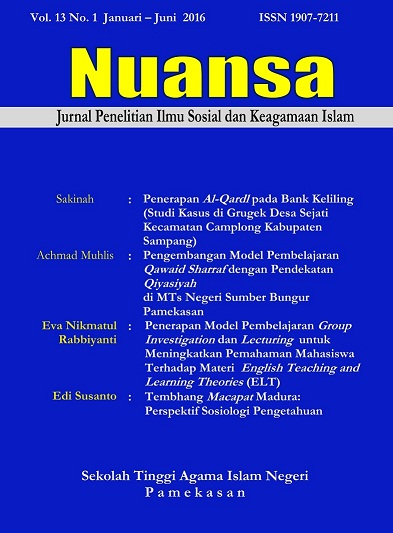
TEMBHANG MACAPAT MADURA: PERSPEKTIF SOSIOLOGI PENGETAHUAN
DOI:
https://doi.org/10.19105/nuansa.v13i1.885Abstract
This article is about to describe Tembhang Macapat in the tradition of Madurese people, particularly in the village of Larangan Luar that is located in Larangan district of Pamekasan regency. It has been stated that Tembhang Macapat appears as cultural treasure that its existence needs to conserve. However it is as well claimed as out of dated culture since its noble and gallant values have been decreased. Hence structured and thoughtful attempts must be designed to promote Tembhang Macapat and the other traditional treasures in form of local content curriculum. Furthermore the department in charge, The Youth, Sport, and Cultural Affairs (Disporabud), must get optimally involved to look after and develop the local tradition by supporting any events of tradition development. As a result it could raise and fertilize the local tradition everlastingly or at least it is able to survive in the future time.ÂDownloads
References
Bafadal, Ibrahim. “Teknik Analisis Data Penelitian Kualitatifâ€, dalam Masykuri Bakri. Ed, Metodologi Penelitian Kualitatif: Tinjauan Teoritis dan Praktis. Malang: Lemlit Unisma dan Visipress, 2002.
Bogdan, Robert C. dan S. Knoop Biklen, Qualitative Research for Education: An Introduction to Theory and Methods. Boston: Allyn and Bacon, t.t.
Bouvier, Helene. “Musik dan Seni Pertunjukan di Kabupaten Sumenepâ€, dalam Huub de Jonge, ed. Agama, Kebudayaan dan Ekonomi: Studi-Studi Interdisipliner tentang Masyarakat Madura. .Jakarta: Rajawali Pers, 1989.
Ghazali, A. Syukur. “Naskah Angling Dharma Ambya Maduraâ€, Sari 19. 2001.
Imron, D. Zawawi. “Sastra Madura: Yang Hilang Belum Bergantiâ€, dalam Huub de Jonge, ed. Agama, Kebudayaan dan Ekonomi: Studi-Studi Interdisipliner tentang Masyarakat Madura. Jakarta: Rajawali Pers, 1989.
Kuntowijoyo, Budaya dan Masyarakat. Yogyakarta: Tiara Wacana, 2006.
Kusumayati, AM. Hermien dan Suminto A. Sayuti, “Eksistensi Sastra Lisan Mamaca di Kabupaten Pamekasan Maduraâ€, Litera Volume 13 Nomor 1 April 2014.
Rifa’i, Mien Ahmad. Manusia Madura: Pembawaan, Perilaku, Etos Kerja, Penampilan dan Pandangan Hidupnya Seperti Dicitrakan Peribahasanya. Yogyakarta: Pilar Media, 2007.
Rifai, Mien A,. dan Nurinwa Ki S. Hendrowinoto, Mohammad Noer.Jakarta: Yayasan Biografi Indonesia, 1991.
Salam, Solichin. Sekitar Wali Songo. Kudus: Menara, 1960.
Sastrodiwirjo, Oemar. Tembhang Macapat Madura. Surabaya: Karunia, 2008.
Sudikan, Setya Yuwana. Metode Penelitian Kebudayaan. Surabaya: Universitas Negeri Surabaya Press, 2001.
Syamsuddin, Muh. “Agama, Migrasi dan Orang Maduraâ€, Aplikasia Jurnal Aplikasi Ilmu-Ilmu Agama, Vol. VIII No 2 Desember 2007.
Tim Penelitian Fakultas Sastra Universitas Negeri Jember, Seni Macapat Madura. Jember: Proyek Penelkitian Madura dalam Rangka kerja sama Indonesia-Belanda untuk Pengembangan Studi tentang Indonesia, 1980.
Tjiptoatmodjo, FAS. Kota-Kota Pantai di Sekitar Selat Madura Abad XVII Sampai Medio Abad XiX. Disertasi.Yogyakarta: Universitas Gajah Mada, 1983.
Usman, Husaini dan Purnomo Setiady Akbar, Metodologi Penelitian Sosial. Jakarta: Bumi Aksara, 2003.
Wiyata, A. Latief. Carok: Konflik Kekerasan dan Harga Diri Orang Madura. Yogyakarta: LkiS, 2002.
Irawan, Jairi. “Membaca Madura dari Serat Mortaseyaâ€, dalam http://www.lontarmadura.com/membaca-madura-serat-mortaseya/ #jxzz 3T3 ChdMrz.
Jawa Pos, Senin, 21 Juli 2008.
Rahman, Jamal D. “Keislaman, Kemaduraan, Keindonesiaan†dalam http://www.lontarmadura.com/keislaman-kemaduraan-keindonesiaan /#jxzz3T3Aat4ga
Downloads
Published
Issue
Section
License
The journal operates an Open Access policy under a Creative Commons Attribution-NonCommercial 4.0 International License (CC-BY-NC) 
Authors who publish with this journal agree to the following terms:
- Authors retain copyright and grant the journal right of first publication with the work simultaneously licensed under a Creative Commons Attribution License that allows others to share the work with an acknowledgement of the work's authorship and initial publication in this journal.
- Authors are able to enter into separate, additional contractual arrangements for the non-exclusive distribution of the journal's published version of the work (e.g., post it to an institutional repository or publish it in a book), with an acknowledgement of its initial publication in this journal.
- Authors are permitted and encouraged to post their work online (e.g., in institutional repositories or on their website) prior to and during the submission process, as it can lead to productive exchanges, as well as earlier and greater citation of published work.