
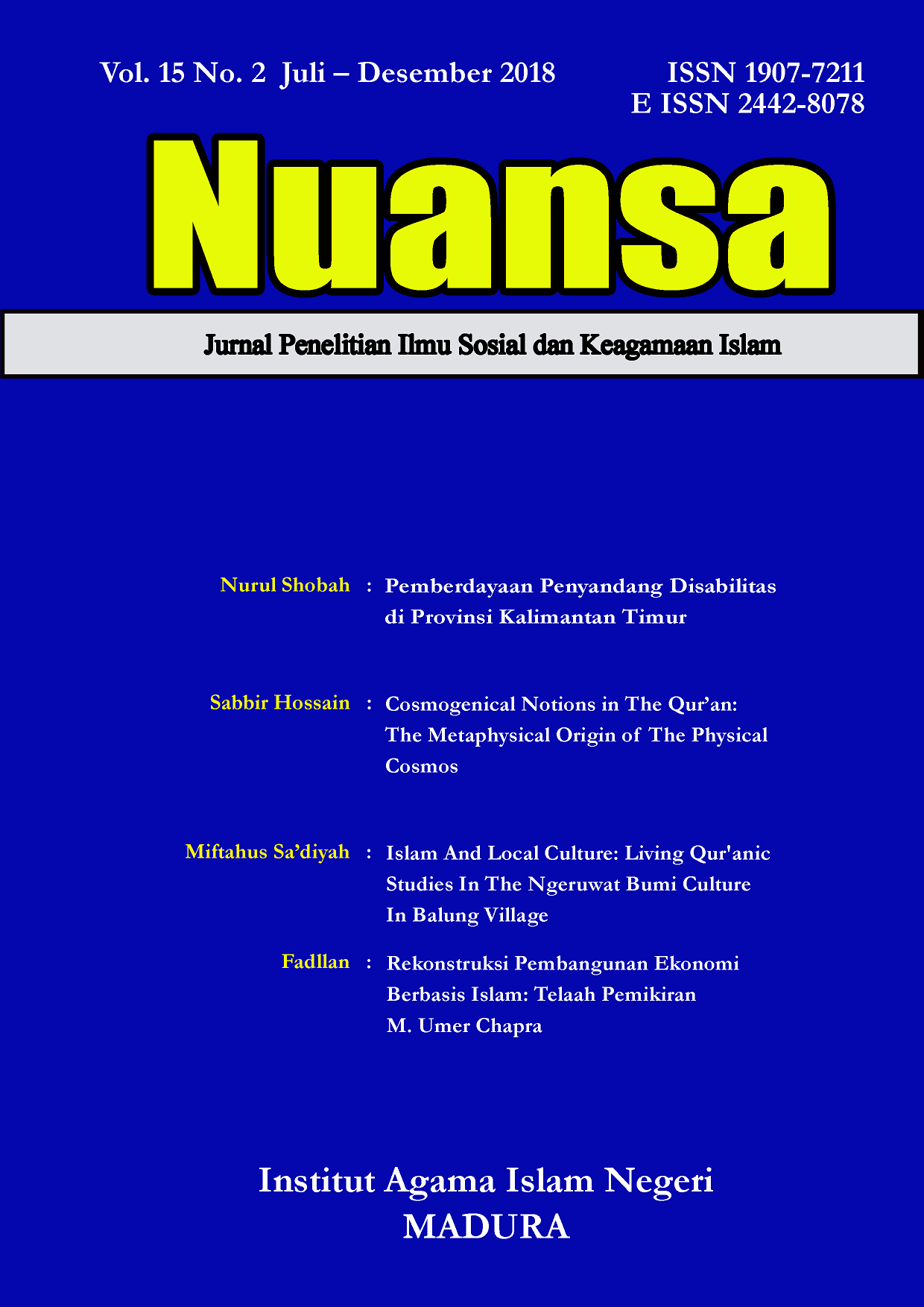
REKONSTRUKSI PEMBANGUNAN EKONOMI BERBASIS ISLAM Telaah Pemikiran M. Umer Chapra
DOI:
https://doi.org/10.19105/nuansa.v15i2.2064Keywords:
Reconstruction, Economic growth, ChapraAbstract
The meaning of “Reconstruction of Economic Growth†in this research is an effort to reconceptualize the economic concepts of conventional development, structure and economic system formulated by West through the mind frame offerred by Muhammad Umer Chapra. This mind set has a purpose of reconstructuring the economic growth that can make the society prosperous as the Islamic teaching law, so that it can create a new theory as a future economic developmental concept. To build a fairness economic system and to reach the economic goals, M. Umer Chapra offerred a reconstruction on some strategic elements. They are filter mechanism which stressed on the moral filter, people’s motivation to put social interests forward, socioeconomical reconstruction, and the country complementer’s active role in economy. To make it true, he offerred some policies, they are: 1) enlighting the humanity factors; 2) decreasing the property concentration; 3) making the economic reconstruction; 4) making fund reconstruction; 5) making a strategic policy with the society’s welfare as the orientation. The essence of all his offering about economic growth is a balanced development in two sides, economy and moral. Because it is impossible to bulid a fairness welfare without any moral development.Downloads
References
Afzalurrahman, Muhammad Sebagai Seorang Pedagang, terj. Dewi Nurjulianti, dkk., Jakarta: Yayasan Swarna Bhumy, 1997.
Ahmad, Khurshid, ed., Islamic Perspectives, Leicester: Islamic Foundation, 1979.
---------, dalam pengantar karya M. Umer Chapra, Islam dan Tantangn Ekonomi; Islamisasi Ekonomi Kontemporer, terj. Nur Hadi Ihsan dan Rifqi Amar, cet. I, Surabaya: Risalah Gusti, 1999.
Boullata, Issa J., Dekonstruksi Tradisi: Gelegar Pemikiran Arab Islam, Yogyakarta: LkiS, 2001.
Capra, Fritjof Titik Balik Peradaban, Sains, Masyarakat dan Kebangkitan Kebudayaan, terj. M. Thoyibi, Yogyakarta: Yayasan Bentang Budaya, 1997.
Chapra, M. Umer, Islam and Economic Development, Islamabad: The International Institute of Islamic Thought, 1993
---------, Sistem Moneter Islam, terj. Ikhwan Abidin Basri, Jakarta: Tazkia Institut, 2000.
---------, Islam dan Pembangunan Ekonomi, terj. Ikhwan Abidin Basri, Jakarta: Tazkia Institute, 2000.
---------, Islam dan Tantangn Ekonomi; Islamisasi Ekonomi Kontemporer, terj. Nur Hadi Ihsan dan Rifqi Amar, cet. I, Surabaya: Risalah Gusti, 1999.
---------, The Future of Economics: An Islamic Perspective, Leicester, UK: The Islamic Foundation, 2000.
Chuodhury, Masudul Alam, Contribution To Islamic Economic Theory; A Study in Sosial Economic, New York: St. Martin’s Press, 1986.
Djojohadikusumo, Sumitro, Perkembangan Pemikiran Ekonomi: Dasar Teori Ekonomi Pertumbuhan dan Ekonomi Pembangunan, Jakarta: LP3ES, 1984.
Fadllan, Sejarah Pemikiran Ekonomi Islam, Surabaya: Pena Salsabila, 2013.
Fakih, Mansour Masyarakat Sipil Untuk Transformasi Sosial, Pengelolaan Ideologi LSM Indonesia, Jakarta: Pustaka Pelajar, 2000.
Ghazali, Ihya Ulum ad-Din, Kairo: Ali Subaih, 1982.
Heilbroner, Robert L., Terbentuknya Masyarakat Ekonomi, terj. Sutan Diajung, Jakarta: Galia Indonesia, 1982.
Hidayat, Komaruddin, Memahami Bahasa Agama; Sebuah Kajian Hermeneutik, Jakarta: Paramadina, 1996.
Howard, Roy J. Pengantar Atas Teori-Teori Pemahaman Kontemporer: Hermeneutika, Wacana Analitik, Psikososial, dan Ontologis, terj. Kusmana dan M.S. Nasrullah, Bandung: Nuansa Cendikia, 2000.
Mannan, M. Abdul, Teori dan Praktek Ekonomi Islam, terj. M. Nastangin, Yogyakarta: PT. Dana Bhakti Wakaf, 1997.
Marbun, B.N., Kamus Politik (Jakarta: Pustaka Sinar Harapan, 1996), hlm. 469.
Raharjo, M. Dawam, Pragmatisme dan Utopia: Corak Nasionalisme Ekonomi Indonesia, Jakarta: LP3ES, 1992.
----------, “Sekapur Sirihâ€, dalam M. Umer Chapra, Islam dan Tantangn Ekonomi; Islamisasi Ekonomi Kontemporer, terj. Nur Hadi Ihsan dan Rifqi Amar, cet. I, Surabaya: Risalah Gusti, 1999.
Roxborough, Ian, Teori-teori Keterbelakangan, terj. Rohman Achwan, Jakarta: LP3ES, 1986.
Soediyono R, Ekonomi Internasional; Pengantar Lalu-Lintas Pembayaran Internasional, Yogyakarta: Liberty, 1991.
Sugiono, Muhadi, Kritik Antonio Gramsci Terhadap Pembangunan Dunia Ketiga, terj. Cholish, cet. I, Yogyakarta: Pustaka Pelajar, 1999.
Sumaryono, E., Hermeneutik, Sebuah Metode Filsafat, Edisi Revisi, Yogyakarta: Kanaisius, 1999.
Suntana, Ija, Politik Ekonomi Islam: Siyasah Maliyah; Teori-Teori Pengelolaan Sumber Daya Alam, Hukum Pengairan Islam dan Undang-Undang Sumber Daya Air di Indonesia, Bandung: CV. Pustaka Setia, 2010
Syâtibî, Abû Ishâq, al-Muwâfaqât fî Usûl al-Syarî’ah, Juz II, Beirut: Dâr al-Kutub al-‘Ilmiah, 2000
----------, al-Muwafaqat fi Ushul al-Ahkam, Jilid 2, Kairo: Mustafa Muhammad, 1984.
Winardi, Kapitalisme Versus Sosialisme: Suatu Analisis Ekonomi Teoritis, Bandung: Remadja Karya, 1986.
Su’aidi, Mohammad Zaki, “Pemikiran M. Umer Chapra Tentang Masa Depan Ekonomi Islamâ€, dalam Jurnal Ishraqi, Vol. 10 No. 1 Juni 2012.
“Pembinaan Manusia Jadi Prioritasâ€, Majalah Sabili, 94 April 2002.
Downloads
Published
Issue
Section
License
The journal operates an Open Access policy under a Creative Commons Attribution-NonCommercial 4.0 International License (CC-BY-NC) 
Authors who publish with this journal agree to the following terms:
- Authors retain copyright and grant the journal right of first publication with the work simultaneously licensed under a Creative Commons Attribution License that allows others to share the work with an acknowledgement of the work's authorship and initial publication in this journal.
- Authors are able to enter into separate, additional contractual arrangements for the non-exclusive distribution of the journal's published version of the work (e.g., post it to an institutional repository or publish it in a book), with an acknowledgement of its initial publication in this journal.
- Authors are permitted and encouraged to post their work online (e.g., in institutional repositories or on their website) prior to and during the submission process, as it can lead to productive exchanges, as well as earlier and greater citation of published work.