
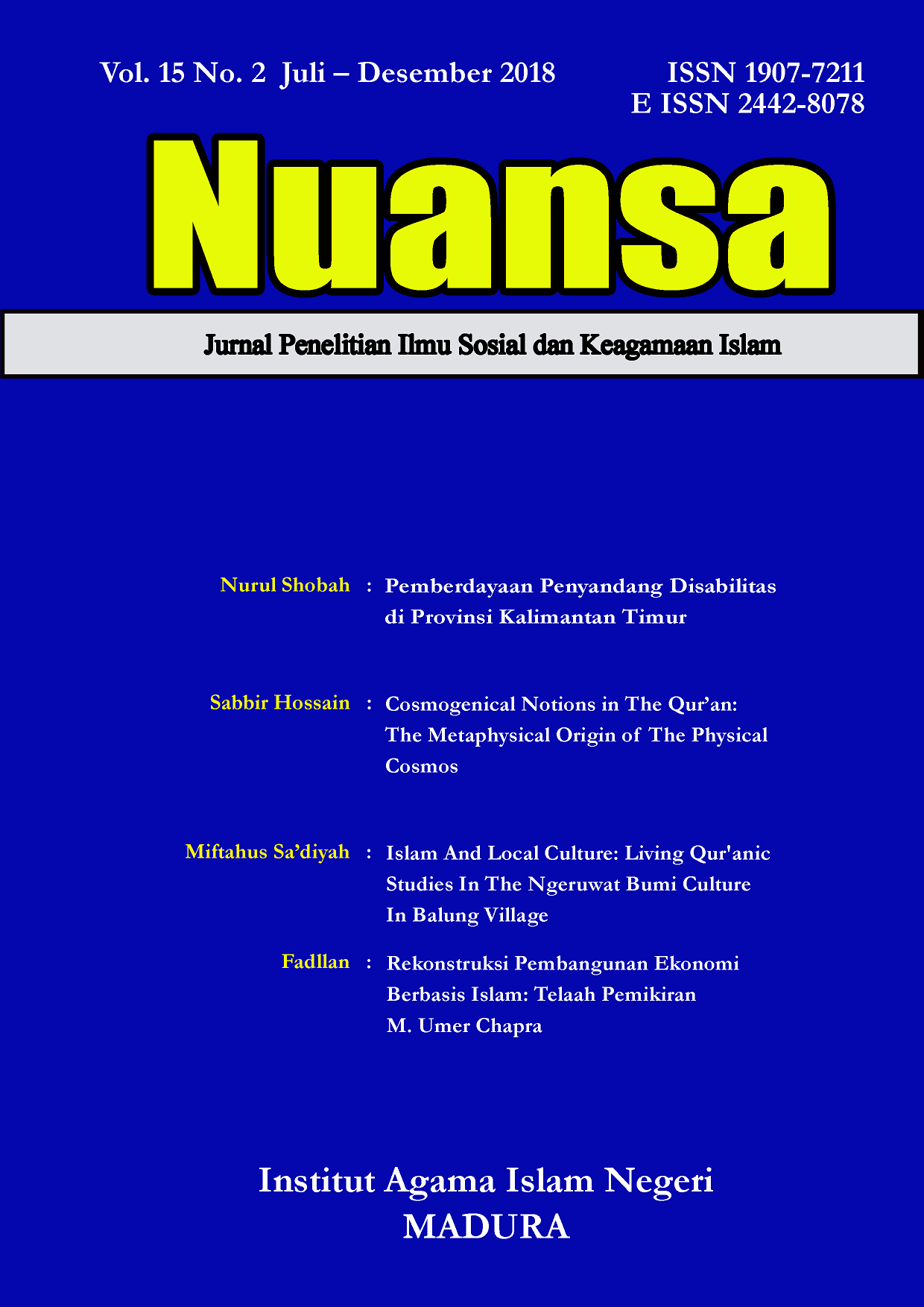
COSMOGENICAL NOTIONS IN THE QUR’AN: THE METAPHYSICAL ORIGIN OF THE PHYSICAL COSMOS
DOI:
https://doi.org/10.19105/nuansa.v15i2.2058Keywords:
Cosmogony, Islam, DoctrineAbstract
Upon distinguishing cosmogony – the ultimate origin of the cosmos – from cosmogony – the early state of the cosmos, the paper presents a Qur’anic account of cosmogeny based on three relevant verses. The articulated Qur’anic cosmogeny of the paper affirms the doctrine of creatio ex nihilo and reveals the metaphysical origin of the cosmos. A number of cosmogenical principles are also presented in the article, which further demonstrate and reaffirm the theocentric nature of Qur’anic as well as Islamic cosmologies. The denouncement of absolute nothingness as per the newly-formulated cosmogeny and its principles presented in the paper certainly indicates the fundamental difference between the natures of the reality and the Ultimate Reality in Islam.Downloads
References
Md Sabbir Hossain, “Scientific Cosmology and Religious Or Theological Cosmology From An Islamic Perspectiveâ€. Islam and Civilisational Renewal (ICR). Volume 9. Issue 2. (2018) (Kuala Lumpur: IAIS Malaysia).
Edward Harrison, Cosmology: The science of the universe. 2nd Ed. (Cambridge: Cambridge University Press, 2000).
Ian Ridpath, A Dictionary of Astronomy. Revised 2nd Ed. (New York: Oxford University Press, 2012).
Oliver Leaman, (ed.) The Qur’an: An Encyclopedia (London: Routledge, 2006).
Osman Bakar, Qur'anic Pictures of the Universe: The Scriptural Foundation of Islamic Cosmology (Petaling Jaya: Islamic Book Trust, 2016).
Osman Bakar. Cosmology. In John L. Esposito (ed.). The Oxford Encyclopedia of the Modern Islamic World, pp. 322-328. Vol. 1. (Oxford: Oxford University Press, 1995).
Seyyed Hossein Nasr, Islam: Religion, History, and Civilization (New York: Harper Collins, 2003).
Ismail Razi Al Faruqi, Al Tawhid: Its Implications for Thought and Life (Virginia, USA: International Institute of Islamic Thought (IIIT), 1992).
A.B. Al-Mehri (Editor), The Qur’an: With Surah Introductions and Appendices -Saheeh International Translation (The Qur’an Project. Brimingham, UK: Maktabah Publications, (2013).
Seyyed Hossein Nasr (ed.), The Study Quran: A New Translation and Commentary (San Francisco: HarperOne, 2017).
Al-Qurtubi, Tafsir Al-Qurtubi: Classical Commentary of the Holy Qur’an. Aisha Bewley (Trans). Vol. 1. (London: Dar Al-Taqwa, 2003)
Abdulla Galadari, “Creatio Ex Nihilo and the Literal Qur’anâ€, Intellectual Discourse, Vol. 25, No. 2, 381–408, 2017 (International Islamic University Malaysia, IIUM Press, Kuala Lumpur).
Daniel Carl Peterson. Creation. In Jane Dammen McAuliffe (ed.) Encyclopaedia of the Qur’an. Vol. 1, 472-480, (Brill: Leiden, The Netherlands, 2001).
Seyyed Hossein Nasr. Islam, Science, Muslims and Technology: Seyyed Hossein Nasr in conversation with Muzaffar Iqbal, (Islamabad: Dost Publications, 2009).
Haslin Hasan & Hafiz Tuah, “Quranic Cosmogony: Impact of Contemporary Cosmology on the Interpretation of Qur’anic Passages Relating to Origin of the Universeâ€, Kyoto Bulletin of Islamic Area Studies. 7:124-140, 2014, (Japan).
Christopher Longhurst, “Islamic Cosmogony according to Surah Al-Hashr Verse 24: He is Allah, the Creator, The Originator, The Fashioner of Formsâ€. European Scientific Journal. 2: 116-125. 2013, (European Scientific Institute, ESI).
Seyyed Hossein Nasr, An introduction to Islamic cosmological doctrines; conceptions of nature and methods used for its study by the Ikhwan al-Ṣafaʼ, al-Biruuni, and Ibn Sina. Revised Ed. (Great Britain: Thames and Hudson, 1978).
Al-Ghazali, Al-Maqsad Al-Asma. Trans. By Robert Charles Stade. Ninety-Nine Names of God in Islam (Ibadan, Nigeria: Daystar Press, 1970)
Downloads
Published
Issue
Section
License
The journal operates an Open Access policy under a Creative Commons Attribution-NonCommercial 4.0 International License (CC-BY-NC) 
Authors who publish with this journal agree to the following terms:
- Authors retain copyright and grant the journal right of first publication with the work simultaneously licensed under a Creative Commons Attribution License that allows others to share the work with an acknowledgement of the work's authorship and initial publication in this journal.
- Authors are able to enter into separate, additional contractual arrangements for the non-exclusive distribution of the journal's published version of the work (e.g., post it to an institutional repository or publish it in a book), with an acknowledgement of its initial publication in this journal.
- Authors are permitted and encouraged to post their work online (e.g., in institutional repositories or on their website) prior to and during the submission process, as it can lead to productive exchanges, as well as earlier and greater citation of published work.