
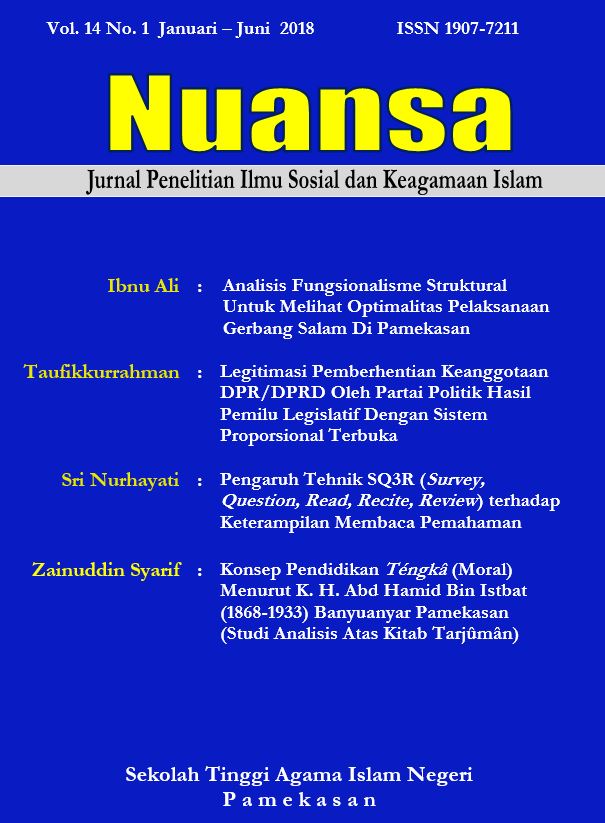
PENGARUH TEHNIK SQ3R (SURVEY, QUESTION, READ, RECITE, REVIEW) TERHADAP KETERAMPILAN MEMBACA PEMAHAMAN
DOI:
https://doi.org/10.19105/nuansa.v15i1.1912Abstract
This study is trying to find a solution to the problem the researcher found in her preliminary study about reading for understanding. SQ3R is an abbreviation of Survey, Question, Read, Recite dan Review. This technique can increase the students’ involvement on the text they read. This technique also helps to form information in the students’ mind and make it meaningful. This research is a kind of quantitaive research to find the effect of implementation of SQ3R in reading for understanding. The treatment is given after gathering the data that both classes are homogenous. After analyzing the post test result, it can be concluded that there is a significant effect on the implementation of SQ3R on the students’ undertanding. It is supported by the data from the questionannaire which show the students’ respond on the implememtation of SQ3R in reading for understanding an Islamic text written in English.Downloads
References
Brown.H. Douglas. Teaching by Principles, an interactive approach to language pedagogy.USA: Pearson Education, Inc, 2007
Dharma Ahmad Surya, “the implementation of SQ3R strategy to teach reading news item text to tenth grade students of senior high school.†Artikel lngkap dikse dari http://ejournal.unesa.ac.id/article/6220/58/article.pdf
R.J Fraenkel,R.J and Wallen, N.E., How to design and evaluate research in education, Boston: Mc.Graw-hill, 2000.
Gay, L.R and Peter A, Educational research competences for analysis and application. New Jersey: Prentice Hall, 2000.
Herlina. 2015. Meningkatkan ketrampilan membaca pemahaman Bahasa Inggris Melalui Tehnik SQ4R.
Indah N Rohmani. Gangguan Berbahasa. Malang: UIN Maliki Press, 2012.
Kartono, Kartini. Pengantar Metodologi Riset Sosial. Bandung: Mandar Maju, 1996.
Lado, Robert. 1998. Language Testing. New York: McGraw-Hill Book Company
Lightbown m Ptasy, Spada Nina. HowLanguages Are Learnt. New York: Oxford University Press, 1999.
Maarof, N., & Yaacob, M. Meaning-making in the first and second language: reading strategies of Malaysian students. Procedia Social and Behavioral Sciences, vol.12 (2011), 211– 223.
Martha Betaubun, The implementation of SQ3R technique in teaching English to support third class students’ ability in reading comprehension at state vocational high school in Merauke- Papua Indonesia, Vol.24 (2016), hlm. 39.
Mahsun, Tehnik Penelitian Bahasa: Tahapan Strategi, Tehnik dan Tekniknya (Edisi Revisi). Jakarta: Rajawali Press, 2011.
Maleong, Loxy L. Tehnik Penelitian Kualitatif (Edisi Revisi). Bandung: PT. Remaja Rosdakarya, 2012.
M. Agus Nuryatno, “Comparing Religious Education in Indonesia and Japan.†Al-Jami’ah Vol. 52, No. 2, 2014 M/ 1435 H.
Moleong, Loxy J. Metodologi Penelitian Kualitatif. Bandung: Remaja Karya, 2002.
Suryabrata, S. Methodology Penelitian. Jakarta: PT. Raja Grafindo Persada, 1997
Suryawinata Z, Hariyanto S. Translation: Bahasan Teori & Penuntun Praktis menerjemahkan. Yogyakarta: Penerbit Kanisius, 2003.
Satya p Anggun dwi, “Penggunaan tehnik pembelajaran SQ3R (Survey, Question, Read, Recite, Review) untuk meningkatkan keterampilan membaca pemahaman dalam mata pelajaran bahasa indonesia†, Vol.4 No.2. Kalam Cendekia PGSD Kebumen. (2016)
Syah, M. Psikologi belajar. Jakarta: Rajawali Press, 2009
Troike M Saville. Introducing Second Language Acquisition. New York: Cambridge University Press, 2006.
Downloads
Published
Issue
Section
License
The journal operates an Open Access policy under a Creative Commons Attribution-NonCommercial 4.0 International License (CC-BY-NC) 
Authors who publish with this journal agree to the following terms:
- Authors retain copyright and grant the journal right of first publication with the work simultaneously licensed under a Creative Commons Attribution License that allows others to share the work with an acknowledgement of the work's authorship and initial publication in this journal.
- Authors are able to enter into separate, additional contractual arrangements for the non-exclusive distribution of the journal's published version of the work (e.g., post it to an institutional repository or publish it in a book), with an acknowledgement of its initial publication in this journal.
- Authors are permitted and encouraged to post their work online (e.g., in institutional repositories or on their website) prior to and during the submission process, as it can lead to productive exchanges, as well as earlier and greater citation of published work.