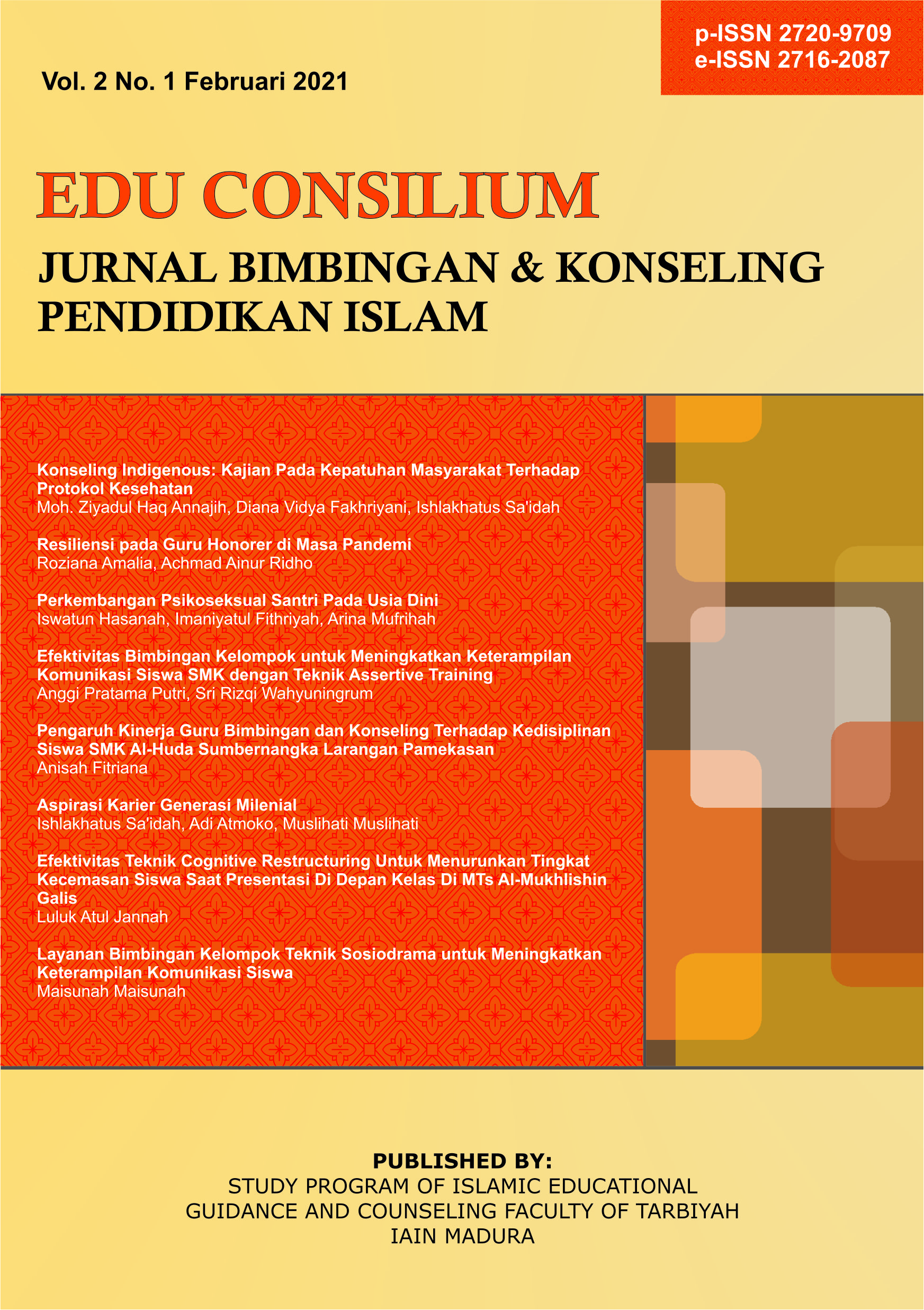
Efektivitas Teknik Cognitive Restructuring Untuk Menurunkan Tingkat Kecemasan Siswa Saat Presentasi Di Depan Kelas Di MTs Al-Mukhlishin Galis
DOI:
https://doi.org/10.19105/ec.v2i1.4224Abstract
Penelitian ini dilatar belakangi Teknik Cognitive Restructuring untuk menurnkan tingkat kecemasan siswa saat presentasi didepan kelas. Teknik ini sangat cocok digunakan untuk menurunkan tingkat kecemasan siswa karena dalam teknik Cognitive Restructuring mengubah pola pikir siswa yang negatif menjadi pola pikir yang lebih positif sehingga dapat mengurangi perasaan cemas saat presentasi di depan kelas. Penelitian ini merupakan penelitian eksperimen dengan mengambil latar di MTs Al-Mukhlisin Galis. Tujuan yang ingin dicapai dalam penelitian ini adalah untuk menguji Teknik Cognitive Restructuringdalam menurunkan tingkat kecemasan siswa saat presentasi di depan kelas di MTs Al-Mukhlisin Galis. penelitian ini menggunakan jenis penelitian pre-eksperimental dengan pre-test dan post-test yaitu pengukuran awal dan pengukuran akhir. Metode pengumpulan data yang digunakan adalah angket dan wawancara untuk mengetahui perubahan tingkat kecemasan siswa saat presentasi di depan kelas setelah diberikan teknik Cognitive Restructuring. Subjek penelitian sebanyak 6 orang. Teknik analisis data yang digunakan adalah teknik analisis statistik non parametrik dengan uji jenjang bertanda wilcoxon. Hasil Penelitian menunjukkan bahwa; 1) teknik Cognitive Restructuring dapat menurunk an tingkat kecemasan siswa saat presentasi di depan kelas. 2) terdapat perbedaan skor tingkat kecemasan siswa antara sebelum dan sesudah diberikan teknik Cognitive Restructuring. Berdasarkan hasil uji jenjang wilcoxon diketahui T hitung = 0, N = 6 siswa dengan taraf signifikan 5%, maka T tabel sebesar 1 yang berarti T hitung lebih kecil T tabel (T hitung ≤ T tabel) yang berarti Ho ditolak dan Ha diterima. Hal ini disimpulkan bahwa teknik Cognitive Restructuring efektif dalam menurunkan tingkat kecemasan siswa saat presentasi di depan kelas di MTs Al-Mukhlisin. [This research is based on the Cognitive Restructuring Technique to reduce students' anxiety levels when presenting in front of the class. This technique is very suitable to be used to reduce students' anxiety levels because in the Cognitive Restructuring technique it changes negative student thought patterns into more positive ones so as to reduce feelings of anxiety during presentations in front of the class.This research is an experimental study with a background at MTs Al-Mukhlisin Galis. The aim of this research is to test the Cognitive Restructuring Technique in reducing students' anxiety levels during presentations to the class at MTs Al-Mukhlisin Galis. This research uses pre-experimental research with pre-test and post-test, namely the initial measurement and the final measurement. The data collection methods used were questionnaires and interviews to determine changes in students' anxiety levels during presentations in front of the class after being given the Cognitive Restructuring technique. The research subjects were 6 people. The data analysis technique used is the non-parametric statistical analysis technique with the Wilcoxon signed level test.The results showed that; 1) Cognitive Restructuring techniques can reduce students' anxiety levels during presentations in front of the class. 2) there is a difference in students' anxiety level scores between before and after being given the Cognitive Restructuring technique. Based on the results of the Wilcoxon level test, it is known that T count = 0, N = 6 students with a significant level of 5%, then T table is 1 which means T count is smaller T table (T count ≤ T table) which means Ho is rejected and Ha is accepted. It can be concluded that the Cognitive Restructuring technique is effective in reducing students' anxiety levels when presenting to class at MTs Al-Mukhlisin.].Downloads
References
Aqillah, Mushaf, Al-Quran Terjemah dan Tafsir untuk Wanita Tafsir Ibnu Katsir, Tafsir Ath- Thabari, Asbabun Nuzul, Doa dan Zikir Sehari-Hari. Bandung: JABAL. 2010.
Budi Ra’I. Memilih Uji Statistik Dalam Penulisan Skripsi. Surabaya: Unesa University Press. 2000.
Corey, Gerald. Teori dan Praktek Konseling & Psikoterapi. Bandung: PT Refika Aditama. 2013.
Cristy, Chintia Diana, Dkk. Penggunaan Strategi Cognitive Restructuring (CR) Untuk Meningkatkan Efikasi Diri Siswa Kelas X-TSM-1 SMK Negeri 1 Mojokerto, Junal BK UNESA, Volume 04(01) 2013.
Damayanti, Rika, Dkk. Pengaruh Konseling Kognitif Perilaku Dengan Teknik Restruturisasi Kognitif Terhadap Harga Diri Peserta Didik Kelas VIII Di MTs N 2 Bandar Lampung, Jurnal Bimbingan dan Konseling, (Volume 3 (2), 2015.
Fajaruddin, Titin Indah Pratiwi, Penerapan Strategi Cognitive Restructuring Untuk Menurunkan Persepsi Negatif Terhadap Pelaksanaan Program Bimbingan dan Konseling Pada Siswa Kelas X SMA Negeri 1 Karangrejo Tulungagung, jurnal BK, Volume 06 (01), 2016.
Gunarsa, Singgih D. Psikologi Perawatan. Jakarta: PT BPK Gunung Mulia. 2008.
Manggala, Nico. 9 Terapi Untuk Kecemasan Berlebihan (Ansietas). Surabaya: CV Garuda Mas Sejahtera. 2015.
Nursalim, Mochammad. Strategi & Intervensi Konseling. Jakarta: PT Indeks. 2013.
Noviandari, Harwanti, Jawahirul Kawakib. Teknik Cognitive Restructuring Untuk Meningkatkan Self Efficacy Belajar Siswa. Jurnal Psikologi. Volume 3(2). 2006
Purwanto. Metodologi Penelitian Kuantitatif untuk Psikologi dan Pendidikan. Yogyakarta: PUSTAKA PELAJAR. 2008.
Sugiyono. Metode Penelitian Kuantitatif Kualitatif Dan R&D. Yogyakarta: Bandung: ALFABETA. 2010
Sulhan, Najib. Pembangunan Karakter Pada Anak Manajemen Pembelajaran Guru Menuju Sekolah Efektif. Surabaya: SIC Bekerja Sama Dengan Yayasan Al-Azhar Kelapa Gading Surabaya. 2006.
Susanto, Herri. Communication skills “Sukses Komunikasi, Presentasi, dan Berkarierâ€. Yogyakarta: CV Budi Utama. 2004.
Downloads
Published
How to Cite
Issue
Section
License
The journal operates an Open Access policy under a Creative Commons Non-Commercial 4.0 International license. Authors who publish with this journal agree to the following terms:
- Authors retain copyright and grant the journal right of first publication with the work simultaneously licensed under a
 Commons Attribution-NonCommercial 4.0 International License
that allows others to share — copy and redistribute the material in any medium or format, and adapt — remix, transform, and build upon the material.
- Authors are able to enter into separate, additional contractual arrangements for the non-exclusive distribution of the journal's published version of the work (e.g., post it to an institutional repository or publish it in a book), with an acknowledgement of its initial publication in this journal.
- Authors are permitted and encouraged to post their work online (e.g., in institutional repositories or on their website) prior to and during the submission process, as it can lead to productive exchanges, as well as earlier and greater citation of published work (see The Effect of Open Access).