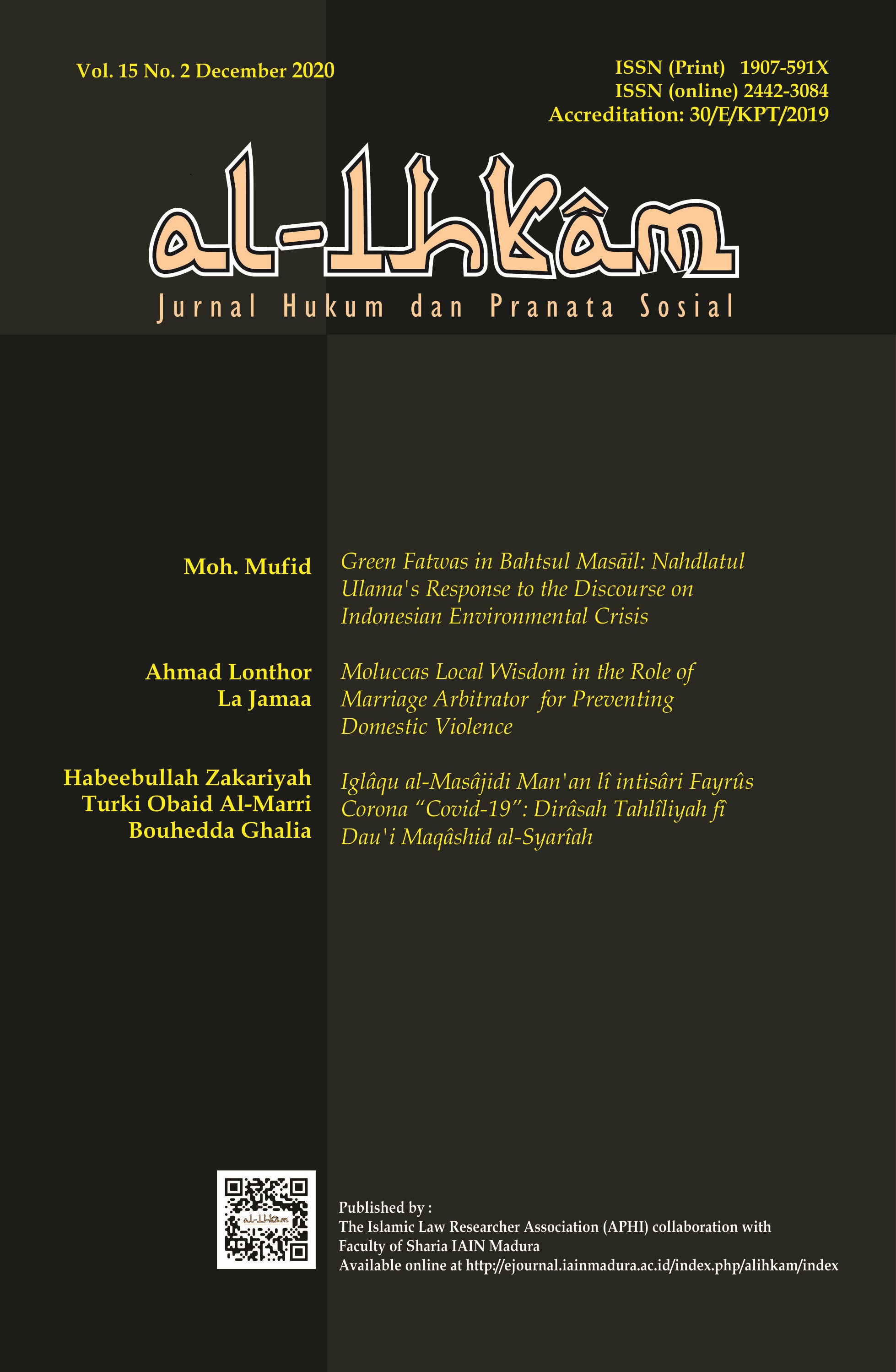
IghlÄq al-MasÄjid Man’an lÄ« intishÄr FayrÅ«s Corona DirÄsah TaḥlÄ«lÄ«yah fÄ« Ḍaw’ MaqÄá¹£id al-SharÄ«`ah
DOI:
https://doi.org/10.19105/al-lhkam.v15i2.4018Keywords:
الكلمات المÙتاØية, مقاصد الشريعة- كوÙيد-19-إغلاق المسجد.Abstract
Many Muslim countries prohibit mosques opening because social gathering is regarded as a high probable factor for Corona Virus infection. This paper discusses different opinions of some contemporary scholars on this issue from the MaqÄá¹£idÄ« perspective. It adopts an analytical method to explain the opinions. Findings show that contemporary scholars are of two group: The first group permits the mosques’ closure for realizing the divine objective concerning to life protection out of danger. The second thinks that the mosques’s closure amounts to suspension of congregational prayer as one of Islamic essential exterior rites. The findings illustrate that the life protection constitutes a necessary benefit because putting life in danger is a very serious harm. The life protection is more important than congregational prayer’s objective which complements the necessary objective of religious protection. Moreover, it shares the spirit with the principle saying that any means to achieving what is compulsory also becomes compulsory accordingly. Above all, prohibition of congregational prayer is just a momentary legal permit due to a necessity on its merit the research recommends that religious institution should make people aware to take all measures in stopping the spread of Covid-19 pandemic.
أمرت كثير من الدول الإسلامية بإغلاق المساجد باعتبار أن التجمع Ùيها يمثل سببا Ù…Øتملا لوقوع العدوى. تهد٠الورقة إلى مناقشة آراء العلماء المعاصرين وأدلتهم تجاه هذه القضية وتØليلها ÙÙŠ ضوء مقاصد الشريعة. استخدمت الورقة المنهج التØليلي ÙÙŠ بيان آراء العلماء المعاصرين والموازنة بين المقاصد. أظهرت نتائج الورقة أن العلماء المعاصرين منقسمون إلى قسمين: ÙطائÙØ© ترى جواز إغلاق المساجد؛ لأنه ÙŠØقق مقصود الشارع ÙÙŠ ØÙظ النÙوس من الهلاك، وطائÙØ© أخرى ترى أن هذا الإغلاق تعطيل لشعيرة صلاة الجماعة التي هي شعيرة من شعائر الإسلام الظاهرة. كما أوضØت النتائج أن مصلØØ© ØÙظ النÙس تمثل مقصدا ضروريا ÙˆÙوات الأنÙس ضرر لا يمكن جبره؛ وهو أقوى ÙÙŠ مرتبته من مقصد الصلاة جماعة من Øيث إنه ÙÙŠ مرتبته مكمل لضروري ØÙظ الدين. وأن تعطيل الجماعة ÙÙŠ الصلاة يمثل رخصة مؤقتة ولضرورة تقدر بقدرها، ولأنها شعار المسلمين، Ùهو مصلØØ© مكملة لضروري ØÙظ الدين، وعليه Ùالتعارض واقع بين مقصدين متÙاوتين ÙÙŠ المرتبة، وعليه، Ùالقول بÙتوى غلق المساجد Ø£Ø±Ø¬Ø Ø¨Ø§Ø¹ØªØ¨Ø§Ø± تØقيق المناط؛ ولأنه ÙŠØقق مقاصد الشريعة العليا المتمثلة ÙÙŠ ØÙظ الأنÙس المعصومة من الهلاك ÙÙŠ الجملة. وتوصي الورقة المؤسسات الدينية بالقيام بتوعية الناس بأهمية اتخاذ التدابير الاØترازية لمنع تÙشي هذه الجائØØ© العالمية "كوÙيد-19".
Downloads
References
AbÅ« Ya’lÄ Aḥmad bin `AlÄ« bin Mutsna bin Yaḥya bin ‘IsÄ bin ḤilÄl al-TamÄ«mÄ«, Musnad Abi Ya’lÄ, Tahqiq: Ḥusain SÄlim Asad, Damaskus: Dar al-Ma’mun li at-Turats, 1984.
Aḥmad bin `AlÄ« bin Ḥajar AbÅ« al-Faá¸l al-AsqalÄnÄ«, Fatḥ al-BÄrÄ« Sharḥ á¹¢aḥīḥ al-BukhÄrÄ«, Beirut: Dar al-Ma’rifat, 1379.
Muḥammad bin IsmÄ’īl AbÅ« `Abd Allah Al-BukhÄrÄ«, al-JÄmi’ al-Musnad al-á¹¢aḥīh, Beirut: Dar Najah, 1422.
AbÅ« ḤÄmid Muḥammad bin Muḥammad Al-GhazÄlÄ«, al-Mustaá¹£fÄ, Beirut: Dar al-Kutub al-‘Ilmiyyah, 1993.
Fakhr al-DÄ«n al-RÄzÄ«, al-Mahṣūl fi ‘Ilm Uá¹£ul al-Fiqh, Beirut: Mu’assasah al-Risalah, 1997.
IbrÄhÄ«m bin MÅ«sÄ Al-Shaá¹ibÄ«, al-MuwÄfaqÄt, Riyadh: Dar Ibnu ‘Affan, 1997.
JalÄl al-DÄ«n al-SuyÅ«á¹i, al-Ashbah wa al-NaẓÄ’ir, Beirut: Dar al-Kutub al-‘Ilmiyyah, 1990.
Muḥammad á¹¢idqÄ« bin Aḥmad bin Muḥammad Al-Borneo, Mawsū’ah al-QawÄ’id al-Fiqhiyyah, Beirut: Mu’assasah al-Risalah, 2003.
Asnawi, `Abd al-Raḥīm bin al-Ḥasan al-AsnawÄ«,, NihÄyah al-SÅ«l Sharḥ MinhÄj al-Wuṣūl, Beirut: Dar al-Kutub al-‘Ilmiyyah, 1999.
Ibn `Amir al-Hajj, al-Taqrīr wa al-Taḥbīr, Beirut: Dar al-Kutub al-‘Ilmiyyah, 1983.
Abu al-Hasan Ali bin Khalaf bin `Abd Malik Ibn Baá¹Äl, Sharḥ á¹¢aḥīḥ al-BukhÄrÄ« li Ibn al-Baá¹Äl, Riyadh: Maktabah Rusyd, 2003.
TaqÄ« al-DÄ«n Aḥmad bin `Abd al-Ḥalim Ibn Taymiyah, Majmū’ al-FatÄwÄ, al-Riyadh: Maktabah ‘Abikan, 1319.
Mas’ūd á¹¢abrÄ«, FatÄwa al-‘UlamÄ’ Hawl FairÅ«s KÅ«rÅ«na, Qahirah: Dar al-Basyir, 2020.
Muḥammad bin Aḥmad bin Muḥammad bin `Abd Allah Ibn Juzai, al-Qawanin al-Fiqhiyyah.
Al-AmÄ«r `Ala’ al-DÄ«n bin BalbÄn al-FÄrisÄ«, al-IḥsÄn fi TaqrÄ«b á¹¢aḥīḥ Ibn HibbÄn, Beirut: Mu’assasah al-Risalah, 1988.
Muḥammad bin IsmÄ’īl bin á¹¢alÄḥ bin Muḥammad al-ḤusnÄ«, Uṣūl al-Fiqh al-MusammÄ IjÄbah al-SÄ’il Sharḥ Bughyah al-’Āmil, Beirut: Mu’assasah al-Risalah, 1986.
Muḥammad bin YÅ«suf bin AbÄ« al-QÄsim bin YÅ«suf al-‘AbdarÄ« al-Ghurnaá¹Ä«, al-TÄj wa al-IklÄ«l li Mukhtaá¹£ar al-KhalÄ«l, Beirut: Dar al-Kutub al-‘Ilmiyyah, 1994.
Muslim bin al-ḤajjÄj al-Qusyayri al-NaysabÅ«rÄ«, á¹¢aḥīḥ Muslim, Qahirah: Dar Ihya’ al-Kutub al-Arabiyyah al-Aisi al-Baabi al-Hali wa Syirkah, 1991.
SulaymÄn bin Aḥmad bin AyyÅ«b bin Muá¹Ä«r al-LakhmÄ« al-SyÄmÄ« AbÅ« al-QÄsim al-ṬabrÄnÄ«, al-Mu’jam al-KabÄ«r, Qahirah: Maktabah Ibnu Taimiyah, 1994.
Downloads
Published
Issue
Section
License
In order to be accepted and published by Al-Ihkam: Jurnal Hukum dan Pranata Sosial, author(s) submitting the article manuscript should complete all the review stages. By submitting the manuscript, the author(s) agreed to the following terms:
- The copyright of received articles shall be assigned to Al-Ihkam: Jurnal Hukum dan Pranata Sosial as the publisher of the journal. The intended copyright includes the right to publish articles in various forms (including reprints). Al-Ihkam: Jurnal Hukum dan Pranata Sosial maintain the publishing rights to the published articles.
- Authors are permitted to disseminate published articles by sharing the link/DOI of the article at Al-Ihkam: Jurnal Hukum dan Pranata Sosial. Authors are allowed to use their articles for any legal purposes deemed necessary without written permission from Al-Ihkam: Jurnal Hukum dan Pranata Sosial with an acknowledgment of initial publication to this journal.
- Users/public use of this website will be licensed to CC-BY-SA.